
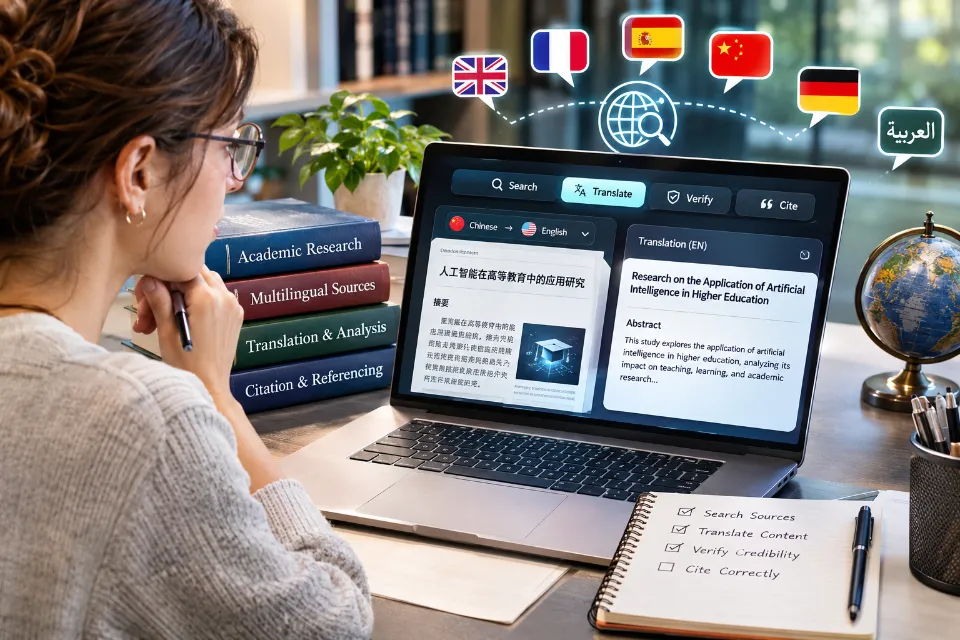
Most literature searches quietly stop at the edge of the English language. It is a convenient habit, but it leaves a lot of evidence on the table. When Amano, González-Varo and Sutherland (2016) searched Google Scholar in 16 languages for biodiversity conservation research published in a single year, 35.6% of the 75,513 documents they found were not in English. Many of those papers could not be reached with an English query at all: in a sample of Spanish-language documents, nearly half had neither an English title nor an English abstract.
Multilingual academic research closes that blind spot, and it works best as a four-step process: search for original sources, translate the relevant material, verify the translation against the source, and cite the original publication accurately. Throughout the process, AI translation should be treated as an aid to discovery and comprehension. It is not a substitute for source verification or for human judgment.
Researchers have more ways in than ever. The AOFIRS Research Tools & Intelligence Hub currently lists 155 research resources across 12 categories, including Academic & Scientific, AI Research, Fact Checking & Verification, Web Archives, and Search Engines & Databases. Used together, they make it practical to move beyond English-only search and follow academic evidence across languages.
What Is the Best Workflow for Multilingual Academic Research?
A reliable multilingual workflow keeps discovery, translation, verification, and citation as separate stages. That separation can feel like extra admin, but it guards against the most common mistake in cross-language work: treating an AI-generated translation or summary as if it were the original evidence.
| Stage | Main Task | What to Check |
|---|---|---|
| 1. Search | Find original foreign-language sources | Author, publisher, date, DOI, relevance |
| 2. Translate | Understand relevant material | Terminology, context, tables, formatting |
| 3. Verify | Compare translation with the source | Numbers, quotations, names, claims |
| 4. Cite | Document the original source | Author, title, year, DOI/URL, translation note |
This is the same discipline professional internet researchers apply to any investigation. AOFIRS describes its research workflows as step-by-step methods to discover, verify, analyze and document online evidence. The four stages above are that method, applied to sources written in another language.
Does Searching Beyond English Really Change the Evidence?
It depends on the field, and it is worth being honest about that. In clinical medicine the picture is fairly reassuring. A systematic review of methods studies found that limiting evidence syntheses of interventions to English-language publications rarely changed their conclusions, although statistical significance did shift in 23 of 259 meta-analyses (Dobrescu et al., 2021). The authors also point out that none of the studies they reviewed looked at diagnostic accuracy reviews, so the result should not be stretched too far.
Other fields look very different. Conservation science, regional public health, education policy, law, and local history are often published first, and sometimes only, in the language of the place being studied (Amano et al., 2016). The same holds outside academia. Market sizing for a new country, competitor benchmarking, and business fact-checking routinely depend on local trade press, regulatory filings, and court records that were never written in English, which is why cross-border work features so heavily in professional research services. A useful rule of thumb: the more local the question, the more likely the best evidence sits in a local language.
How Should Researchers Find Foreign-Language Academic Sources?
Search two layers at once: the large international indexes, and the country- or language-specific repositories where regional scholars actually publish. Use the terminology those scholars use, not just a dictionary equivalent of your English keyword.
Google Scholar is useful for broad scholarly discovery, and its settings let you limit results to pages written in particular languages. PubMed is particularly relevant to biomedical and life-science research. OpenAlex provides an open index covering scholarly works, researchers, institutions, sources, and topics; when it launched, it already held metadata for about 209 million works and offered a free API (Priem et al., 2022). Open aggregators such as BASE (Bielefeld Academic Search Engine), which is listed in the AOFIRS hub, are also good at surfacing institutional repository content that commercial databases miss.
Do not simply translate an English keyword once and reuse it everywhere. Academic terminology often differs from everyday language, and the accepted term can even vary between countries that share a language.
For example, a researcher studying workplace stress could:
- translate the core research concept into the target language;
- review the terminology used in several relevant papers;
- identify alternative academic terms and abbreviations;
- combine those terms with locations, populations, or methodologies;
- search regional university repositories and government databases.
Search operators help here as well. Pairing translated terms with a country’s academic domain, for example site:ac.jp for Japanese universities or site:edu.tr for Turkish ones, narrows results to institutional publications in seconds. This kind of query building is a core skill in professional online research and is covered in the search techniques module of the Certified Internet Research Specialist (CIRS™) program.
Taken together, this approach can uncover research that would never surface from an English-only query.
How Should Foreign-Language Research Papers Be Translated?
Translate only after you have confirmed that a source is relevant and credible, then keep enough context to check important passages later.
A short abstract or a few paragraphs can usually be handled with a general translation system. Larger projects are a different matter. Once you are working with dozens of PDFs, scanned documents, data tables, or recurring technical terms, an ad hoc approach starts producing inconsistent wording that is hard to audit.
For projects of that size, a structured translation workflow keeps source material consistent and easier to review. Platforms such as Pairaphrase combine OCR, formatting preservation, Translation Memory, and terminology management with human review across multilingual documents. Whichever tool you choose, read its data-handling terms before uploading unpublished manuscripts, interview data, or anything covered by an ethics approval.
How Should Researchers Handle Scanned PDFs?
Scanned academic documents need OCR before their text can be translated reliably.
OCR, or Optical Character Recognition, converts image-based text into machine-readable text. It is essential for historical archives, scanned dissertations, older journal articles, government records, and the many image-only PDFs held in web archives and national library collections.
Check the OCR output before relying on the translation, because an OCR error becomes a translation error. This is not a theoretical worry. A study of digitized historical text found that OCR errors had a consistent negative effect on every downstream language-processing task the authors tested, from named entity recognition to information retrieval, and some tasks were damaged severely (van Strien et al., 2020).
Check especially:
- names and institutional titles;
- dates and publication years;
- numerical results;
- statistical values;
- footnotes;
- table headings;
- technical terminology.
Complex formatting adds its own problems. Tables, narrow text boxes, unusual fonts, and multi-column layouts may need manual review even when translation software tries to preserve the original layout. When a number matters, confirm it on the page image rather than in the extracted text alone.
How Can Researchers Work With Multilingual Interviews and Spoken Sources?
Multilingual interviews need both linguistic translation and contextual verification, because meaning can depend on tone, hesitation, idioms, and cultural conventions.
Research increasingly draws on recorded interviews, conference discussions, oral histories, lectures, and field conversations, not just documents. Commercial research is moving the same way, with qualitative interviews and focus groups across several countries now a routine part of market and customer studies.
During multilingual conversations, real-time multilingual speech translation can help researchers follow exchanges across languages without waiting for a complete post-interview translation.
Similarly, AI-assisted voice translation for multilingual conversations can support a preliminary understanding of spoken material. Treat that output as working notes, not as the record.
Keep the original recording whenever consent and research protocols allow, and say in your consent materials that translation tools will be used. Before publication, check every important quotation against the original speech or a reviewed transcript, ideally with a fluent speaker who understands the local context.
How Can Researchers Verify an AI Translation?
Verify any passage that influences your conclusion by comparing the translated version with the original source.
Fluent language is not proof of accurate translation. AI systems can produce grammatically convincing text while misunderstanding terminology, cultural context, negation, or how strongly a claim is made. Accuracy also varies widely by language. When bilingual reviewers checked Google Translate output for emergency department instructions, the meaning survived 94% of the time in Spanish but only 55% of the time in Armenian (Taira et al., 2021).
Figure 1. Share of translated emergency department instructions whose meaning was retained, by target language. Data: Taira et al. (2021). Chart prepared by AOFIRS from the published figures.
Large language models do not make the problem disappear. A study covering more than 100 language pairs found that hallucinated translations, where the output contains content that is not in the source, cluster in low-resource language directions and in translation out of English (Guerreiro et al., 2023). If your source is written in a less widely spoken language, plan for more human checking, not less.
A practical verification checklist is:
- Confirm names, dates, and numbers.
- Compare technical terms with terminology elsewhere in the paper.
- Check quotations against the original passage.
- Verify tables and statistical findings separately.
- Review ambiguous or culturally specific wording.
- Back-translate key sentences with a different tool and treat any mismatch as a flag.
- Use human review when a passage materially affects the research conclusion.
The same principle applies to AI research tools in general. The AOFIRS hub scores tools against weighted criteria that include research usefulness, reliability, transparency, privacy, and value, and it states plainly that a listing is not an endorsement. Recognizing hallucination and bias is also part of the AI module of the CIRS curriculum. Either way, AI output is a lead to verify, not evidence in its own right.
How Should Researchers Cite Foreign-Language Sources?
Cite the original publication, and make it clear which wording comes from the source and which comes from a translation you used to understand it.
Record the original author, title, publication year, journal or publisher, DOI, and stable URL while you are doing the research. Trying to rebuild those details weeks later from a translated copy is where citation errors creep in.
How you present a quotation you translated yourself depends on the required style guide and your institution. In APA Style, your own translation counts as a paraphrase rather than a direct quotation: no quotation marks, an author-date citation, a page number where available so bilingual readers can find the passage, and a reference entry that gives the original title followed by an English translation in square brackets (Adams, 2022). Other conventions allow a note such as “author’s translation” to make clear that the English wording is not an officially published translation.
Your research notes should ideally preserve:
- the original passage;
- the translated passage;
- page or section number;
- DOI or permanent identifier;
- translation method used;
- date accessed;
- any human corrections.
This creates a traceable path from the final claim back to the original evidence, which is exactly what a peer reviewer, an editor, or a client paying for verified research will expect to see.
Why Does Terminology Consistency Matter in Multilingual Research?
Terminology consistency matters because translating the same concept in different ways can change how evidence is grouped and compared.
This is particularly important in medicine, psychology, law, education, engineering, and other fields where one term carries a precise disciplinary meaning. A legal concept rendered three different ways across ten court decisions can make one doctrine look like three.
If you are working across many documents, keep a simple bilingual glossary with the original term, the approved translation, a short definition, and one source example. Translation Memory and terminology-management systems can automate part of this for larger projects.
Consistency does not mean forcing every word into a single translation. Context still matters. The point of terminology control is to spot real differences in meaning, not to create false ones through inconsistent translation.
Frequently Asked Questions
Can AI translate academic research papers?
Yes. AI can help translate academic papers, reports, PDFs, and other research materials, and it is often good enough to tell you whether a source is worth your time. Key terminology, quotations, statistics, and conclusions should still be checked against the original before you cite them.
Can AI translate scanned research PDFs?
Yes, if the software includes OCR. OCR first extracts machine-readable text from the scanned page, and translation happens after that. Poor scan quality can reduce the accuracy of both steps, so check the extracted text first.
Should researchers cite the AI translation tool?
Usually you cite the original scholarly source, not the translation tool, because the tool is not the source of the evidence. Many institutions and publishers now have their own rules on disclosing AI use, so check the policy that applies to your work.
Is Google Scholar enough for multilingual research?
It is a good starting point, but it should not be your only discovery source. Add subject-specific databases, open indexes such as OpenAlex, regional repositories, national libraries, government databases, and web archives.
Do AI-translated sources need human review?
Human review is advisable whenever a translated passage shapes an important interpretation, quotation, finding, or conclusion. The higher the cost of an error, and the less widely spoken the language, the stronger the case for expert linguistic or subject-matter review.
What is the safest way to use AI in multilingual academic research?
Use AI to speed up discovery, translation, and preliminary analysis while keeping the original source on hand for verification. A defensible workflow lets another researcher trace your translated interpretation back to the original document.
Final Takeaway
Multilingual academic research is most reliable when translation is treated as part of the research process rather than as a one-click conversion step.
The practical workflow is simple: find the original source, evaluate its credibility, translate the relevant content, verify the details that matter, preserve the original evidence, and cite transparently. AI can speed up each stage, but academic credibility still depends on traceability, verification, consistent terminology, and human judgment. Those are the same habits that separate professional online research from casual searching, and they are worth building deliberately.
References
Adams, A. (2022, November 21). How to cite your own translations. APA Style Blog. https://apastyle.apa.org/blog/cite-your-own-translations
Amano, T., González-Varo, J. P., & Sutherland, W. J. (2016). Languages are still a major barrier to global science. PLOS Biology, 14(12), e2000933. https://doi.org/10.1371/journal.pbio.2000933
Association of Internet Research Specialists. Research tools & intelligence hub. Retrieved November 4, 2026, from https://aofirs.org/research-tools/
Dobrescu, A. I., Nussbaumer-Streit, B., Klerings, I., Wagner, G., Persad, E., Sommer, I., Herkner, H., & Gartlehner, G. (2021). Restricting evidence syntheses of interventions to English-language publications is a viable methodological shortcut for most medical topics: A systematic review. Journal of Clinical Epidemiology, 137, 209–217. https://doi.org/10.1016/j.jclinepi.2021.04.012
Guerreiro, N. M., Alves, D. M., Waldendorf, J., Haddow, B., Birch, A., Colombo, P., & Martins, A. F. T. (2023). Hallucinations in large multilingual translation models. Transactions of the Association for Computational Linguistics, 11, 1500–1517. https://doi.org/10.1162/tacl_a_00615
Priem, J., Piwowar, H., & Orr, R. (2022). OpenAlex: A fully-open index of scholarly works, authors, venues, institutions, and concepts [Preprint]. arXiv. https://doi.org/10.48550/arXiv.2205.01833
Taira, B. R., Kreger, V., Orue, A., & Diamond, L. C. (2021). A pragmatic assessment of Google Translate for emergency department instructions. Journal of General Internal Medicine, 36(11), 3361–3365. https://doi.org/10.1007/s11606-021-06666-z
van Strien, D., Beelen, K., Coll Ardanuy, M., Hosseini, K., McGillivray, B., & Colavizza, G. (2020). Assessing the impact of OCR quality on downstream NLP tasks. In Proceedings of the 12th International Conference on Agents and Artificial Intelligence (Vol. 1, pp. 484–496). SCITEPRESS. https://doi.org/10.5220/0009169004840496
Recent Post
Nothing Found



