
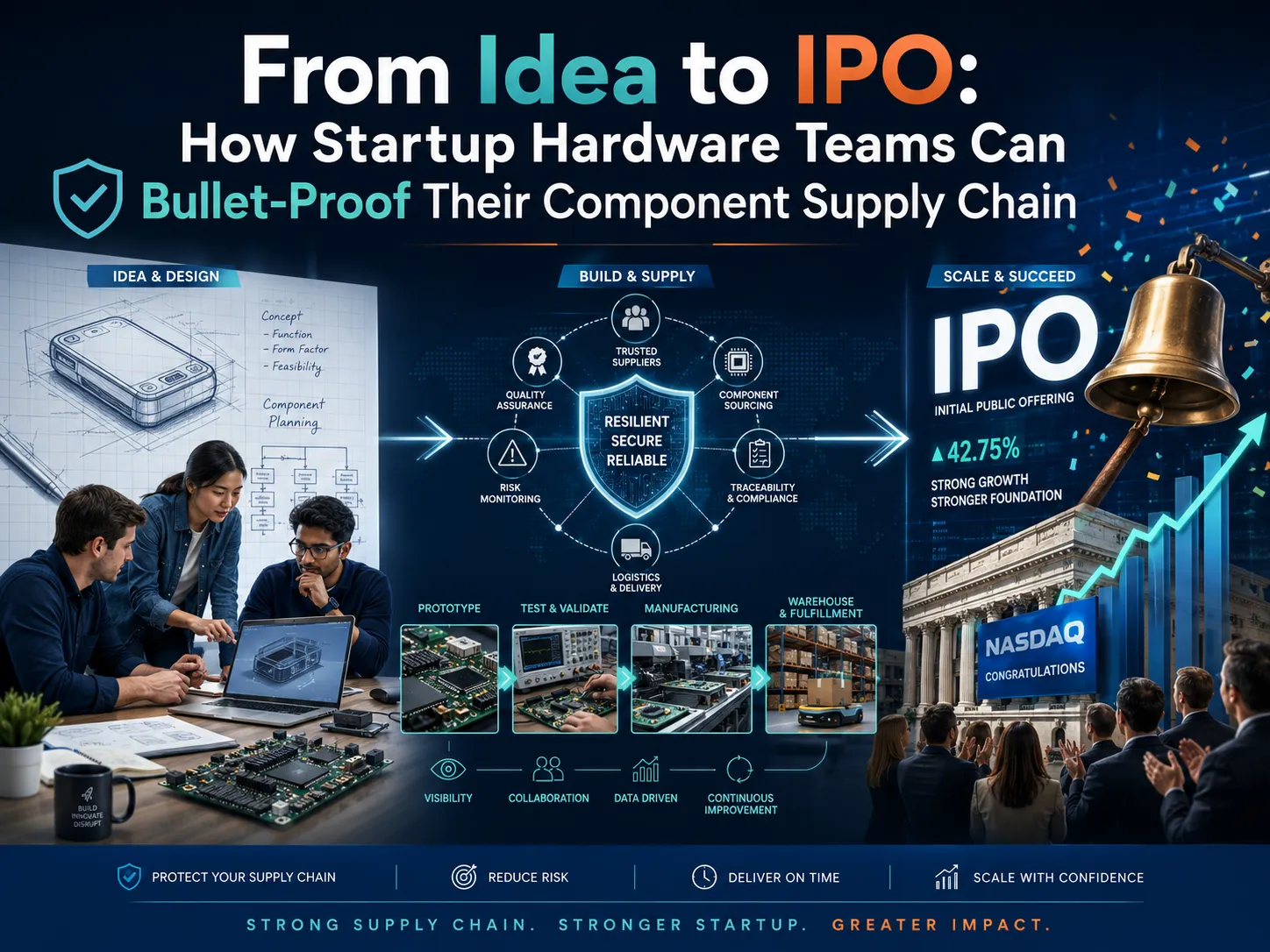
Launching a hardware startup feels like sprinting a marathon. Getting a prototype to blink “hello world” is exhilarating, but the moment you commit to production, a new reality kicks in: every screw, chip, and connector becomes a potential show-stopper.
The 2025 component landscape is calmer than the chaos of 2021–2022, yet shortages, pricing spikes, and geopolitical curveballs still blindside young companies weekly.
This guide lays out a field-tested playbook—mapping BOM risk on day one, building distributor relationships investors applaud, designing boards that shrug off last-minute part swaps, and even turning supply-chain rigor into a slide that raises money.
Follow it and your supply chain becomes an asset, not an existential threat.
The Startup Hardware Supply-Chain Gauntlet
A single week of line stoppage can burn an early-stage firm’s entire quarterly cash reserve. Worse, missed ship dates erode investor trust and open the door for faster-moving rivals. Electronic component shortages are still making life complicated in 2026, with pricing swings and unpredictable lead times.
Founders, therefore, need to treat component strategy with the same urgency as product-market fit.
Two questions founders ask next
- Can’t our contract manufacturer worry about this?
CM partners are helpful, but they don’t bankroll buffer stock for you and they juggle dozens of clients. The risk still lands on your balance sheet.
- Are software-style “move fast” habits really dangerous?
Yes. Hardware has latency: an ill-considered component choice made today can haunt you for seven years of warranty obligations.
Map Your BOM Risk Before You Print Your First PCB
- Classify every part. Tag items as commodity, custom, or at-risk (single-source, long lead, end-of-life).
- Run lifecycle intelligence. Tools like SiliconExpert—or free OSINT databases—flag NRND/EOL notices months sooner, buying you time to redesign.
- Build substitution trees. For each at-risk part, list pad-compatible alternates plus firmware tweaks. Store it with design files—risk data is useless if it lives in a separate spreadsheet.
Extra step: Visualise it. Startups that colour-code their schematic (green = commodity, red = at-risk) help new engineers see landmines instantly.
Follow-up questions answered
- How deep should a substitution tree go?
Minimum two alternates per critical IC; more for passives if they’re unusually specced (e.g., automotive MLCCs).
- What if substitutes exist but require a firmware driver rewrite?
Note the engineering hours next to each alternate so product managers weigh redesign cost against sourcing risk.
Forecast Like a Fortune-500—Without Their Budget
You can’t park two years of inventory the way a mega-cap can, but you can model demand like one.
- Bottom-up volumes. List pilot, EVT, DVT, PVT, then first four mass-production lots.
- Scenario plan. Run best/likely/worst forecasts and tie each to sourcing triggers—e.g., place buffer orders the moment the “likely” curve intersects SMT line capacity.
- Cash-efficient buffers. Heavily buffer cheap passives (pennies each); stagger releases of costly MCUs or sensors on vendor-managed inventory agreements.
- Signal monitoring. Build a Slack bot that pings purchasing when distributor stock of any top-20 part falls below a threshold.
Follow-up questions answered
- What forecast horizon is realistic for a seed-stage company?
Twelve months rolling is plenty. Beyond that, use coarse ranges—investors know revision cycles iterate fast.
- Can historical data from similar products help?
Absolutely. Scrape FCC filings or teardown blogs to see which components peers used and how quickly they scaled; those clues refine your demand curves.
Dual-Source or Die: Practical Approaches to Redundancy
A second supplier isn’t always cheaper, but it’s usually safer.
- Threshold rule. If losing a part halts the line > 48 h, dual-source it.
- Contract hacks. Add “allocation priority” and “equal pricing tiers” clauses that bump your PO up the queue during shortages.
- Design for substitution. Pad-compatible footprints, mezzanine modules, or software-selectable GPIOs let you swap radios, sensors, or regulators without a board re-spin.
- Qualification drills. Run pre-qualification on alternates now—get them through EMC and safety-cert labs while you still have breathing room.
Follow-up questions answered
- What if no second manufacturer exists?
Consider third-party “die banking” services or redesign the function using discrete components.
- Does dual-sourcing hurt unit cost?
Maybe 1–3% higher, but that pales next to the burn rate during a four-week stock-out.
Building Relationships With Independent Distributors
When franchised channels ration parts, independents are a lifeline—if they’re legit.
- Vetting checklist. ISO 9001/AS6081 certs, X-ray & decap inspection gear, escrow/refund policy, documented chain-of-custody.
- Sample early. Place a small RFQ during R&D to test paperwork flow and packaging quality before volume orders matter.
- Stay top-of-mind. Quarterly calls share your rolling forecast so reps alert you to allocation rumours.
Micron and Samsung warn that DRAM lead times and prices will remain high through the year because AI and server demand is outstripping supply.
Resource spotlight. Reputable independents for hard-to-find or EOL parts include ICRFQ, helpful when last-time-buys or surprise shortages threaten your schedule.
Follow-up questions answered
- Is the markup worth it?
- Paying 10% more beats halting production; bake the premium into COGS scenarios.
- How to avoid counterfeit drama?
Require certificates of conformity plus third-party lab reports for any order above USD 5k.
Leveraging Excess-Inventory Marketplaces & Last-Time-Buys
Grey-market horror stories grab headlines, but genuine excess stock from OEM over-buys can rescue a launch.
- Signal vs. noise. Marketplaces that publish lot photos, date codes, and test reports cut risk dramatically.
- Last-time-buy math. Compare the NPV of tying up cash today versus redesign cost if parts vanish tomorrow; spreadsheets beat gut feelings.
- API hookups. Marketplace feeds into your MRP so planners see spot-buy options automatically; flags trigger when price meets your ceiling.
- Shelf-life tactics. For electrolytic caps or batteries, add rolling QC checks to ensure inventory you bought early still meets spec at build time.
Follow-up questions answered
- Can we resell surplus later?
Yes—list unused reels back on the same marketplaces and recoup cash.
- How to store long-lived ICs safely?
Use nitrogen cabinets < 10% RH; bake parts before SMT if they’ve sat > 12 months.
Design for Flexibility: PCB Layout and Firmware Tactics
- Pad-compatible footprints. Library symbols that fit multiple pinouts (e.g., switching between ESP32 and nRF52) save weeks later.
- Voltage headroom. Select regulators with wide input ranges so future alternates fit; target 20% margin.
- Abstraction layers. Modular drivers turn an IMU or BLE swap into a config change, not a rewrite.
- Field-upgradable firmware. Secure OTA updates let you patch timing tweaks if a substitute crystal has higher jitter.
[For a wider lens on adaptable architectures, see iZoneMedia360’s primer on multimodal AI.]
Follow-up questions answered
- Won’t bigger footprints waste board space
A 2 × 2 mm pad margin costs fractions of a cent—cheap insurance.
- How do we manage certification impacts?
Pre-cert alternate parts early; file permissive “family” certifications where possible.
Fundraising Narratives Investors Love: Supply-Chain Edition
Savvy VCs grill hardware teams on part risk. Flip the script and make supply-chain discipline a selling point.
- Slides that pop. Show a heat-mapped BOM, dual-source coverage%, and supplier scorecards. Investors love dashboards.
- Highlight days-of-inventory (DOI) targets that balance burn with resilience; show how DOI flexes under each scenario.
- Moat story. Explain how your sourcing playbook lets you ship when rivals can’t, securing shelf space and PR mindshare.
Follow-up questions answered
- Should we reveal specific supplier names?
Redact pricing but do show categories—transparency builds trust.
- Will investors balk at extra working capital?
Not if you quantify the cost of downtime vs. carrying inventory; spreadsheets beat anecdotes.
The Long Game: From Series C to IPO
Operational discipline eventually matters as much as innovation.
- Conflict-minerals, REACH, and looming PFAS bans require traceability back to smelter—build it now, not under S-1 pressure.
- Audit readiness. Automate supplier declarations inside your PLM so you survive customer and regulator audits without heroics.
- ESG leverage. Responsible sourcing appeals to institutional funds that screen for supply-chain ethics.
Gartner projects the global semiconductor market will top USD 1 trillion annually by 2030, driven largely by AI and industrial-automation demand.
Follow-up questions answered
- How early should we adopt a PLM?
As soon as BOMs exceed 200 lines—manual spreadsheets break fast.
- Are ESG disclosures really examined during IPO?
Yes. Nasdaq and NYSE issuers increasingly publish supply-chain ESG appendices; being ready saves legal bills.
Caveats & Counterpoints
While the tactics above harden your supply chain, perfection is impossible. Over-buffering ties up cash, and dual-sourcing every tiny passive wastes engineering hours. The art is proportionality: invest heavily in single-source silicon, but let commodity 0603 resistors ride the open market.
Likewise, strict vetting can slow urgent spot-buys—set fast-track exception paths with clear sign-offs so risk doesn’t paralyse execution.
Conclusion: Your Prototype Is Only the Starting Line
Great hardware ideas fail at the factory gate more often than in the lab. By mapping risk early, forecasting realistically, cultivating multiple sourcing channels, and designing for flexibility, your team can turn today’s volatile component landscape into a competitive edge.
Companies that master this discipline won’t just survive the next shortage—they’ll ship while competitors scramble.