
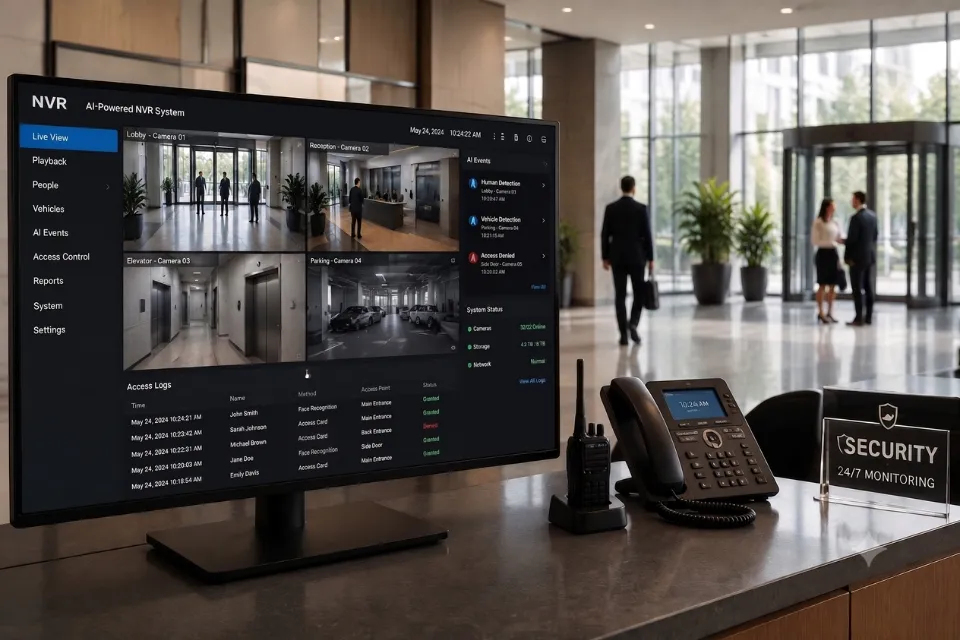
Physical security has evolved far beyond recording surveillance footage. Today, organizations expect their security systems to identify threats, verify access events, and provide actionable insights in real time. This shift is being driven by Artificial Intelligence integrated directly into Network Video Recorders, commonly known as AI NVRs.
The numbers highlight why this technology is gaining momentum. According to MarketsandMarkets, the global video surveillance market is expected to exceed $83 billion by 2030, while Grand View Research estimates the AI in video surveillance market will grow at a CAGR of more than 20 percent throughout the decade. At the same time, Verizon’s latest Data Breach Investigations Report shows that physical security failures and unauthorized access continue to contribute to data breaches and operational disruptions across industries.
Traditional security systems are no longer enough. Recording incidents after they happen provides little value when organizations need to stop threats before they escalate. AI NVR technology changes this by combining intelligent video analytics with access control systems, allowing security teams to detect suspicious behavior, verify identities, and respond instantly.
In this article, you’ll learn how AI NVR technology is transforming access control and video monitoring, the key benefits it offers, practical use cases across industries, and what businesses should consider when deploying an AI-powered security infrastructure.
What Is AI NVR Technology?
A Network Video Recorder stores and manages footage from IP security cameras. Traditional NVRs mainly function as recording devices, allowing users to review footage after an incident occurs.
An AI NVR goes much further.
By integrating artificial intelligence directly into the video management process, it continuously analyzes live camera feeds instead of simply storing them. Rather than relying on manual monitoring, the system automatically identifies events that require attention.
Modern AI NVR platforms can detect:
- Unauthorized entry
- Tailgating
- Loitering
- Intrusion into restricted areas
- Vehicle recognition
- Facial recognition
- Abandoned objects
- Crowd formation
- Unusual behavior patterns
This transforms video surveillance from passive recording into an active security solution.
Why Traditional Access Control Has Limitations
Most access control systems perform one basic function exceptionally well. They determine whether someone has permission to unlock a door.
However, they rarely answer important security questions such as:
- Was the authorized person actually the one who entered?
- Did multiple people follow one authorized user?
- Did someone prop open the door afterward?
- What happened immediately before and after entry?
- Was unusual behavior detected nearby?
Without integrated video intelligence, security personnel must manually search through hours of footage to investigate these situations.
This process consumes valuable time during critical incidents.
AI NVR technology bridges this gap.
Bringing Access Control and Video Monitoring Together
The biggest advantage of AI NVR technology is its ability to connect video surveillance with access control into one intelligent ecosystem.
Instead of treating cameras and door controllers as separate systems, they work together.
For example, when an employee scans an access card, the AI system immediately:
- Confirms the person’s identity through facial recognition
- Associates the access event with corresponding video footage
- Flags unusual behavior
- Alerts operators if verification fails
This level of automation significantly improves both security and operational efficiency.
Real-Time Threat Detection Instead of Incident Review
Traditional surveillance often means discovering incidents hours later.
AI changes that model completely.
Instead of reviewing recorded footage after a theft or intrusion occurs, AI continuously analyzes live streams and immediately identifies potential threats.
Examples include:
Unauthorized Entry
If someone enters through an emergency exit or restricted area, security receives an instant notification.
Tailgating Detection
One of the most common security weaknesses is multiple people entering behind an authorized employee.
AI accurately detects these events and generates immediate alerts.
Suspicious Loitering
When someone remains near a secure entrance longer than expected, AI recognizes unusual behavior and informs operators before a security incident develops.
After-Hours Activity
Businesses can automatically detect movement inside buildings outside approved operating hours.
This proactive approach dramatically reduces response times.
Smarter Identity Verification
Modern organizations are increasingly replacing manual identity checks with AI-assisted verification.
When integrated with access control, AI NVR systems can:
- Match faces against employee databases
- Verify visitor identities
- Detect unauthorized individuals
- Alert security when blacklisted persons appear
- Identify repeated visitors across multiple locations
Unlike manual monitoring, AI performs these tasks continuously without fatigue.
This improves both accuracy and consistency.
Improving Video Search with Artificial Intelligence
One of the most frustrating aspects of traditional surveillance is finding specific footage.
Searching manually through days of recordings wastes valuable resources.
AI NVR technology simplifies investigations using intelligent search.
Instead of browsing timelines, operators can search using natural descriptions such as:
- Person wearing a red jacket
- White pickup truck
- Individual carrying a backpack
- Person entering through the west entrance
- Vehicle parked near loading dock
Results appear within seconds instead of hours.
This capability dramatically improves incident investigations.
Enhancing Visitor Management
Visitors represent one of the largest security challenges for commercial facilities.
Reception staff often verify identification manually while security teams have limited visibility into visitor movement.
AI NVR technology improves this process by:
- Matching visitors with registration records
- Tracking movement throughout authorized areas
- Identifying visitors entering restricted zones
- Monitoring visitor exit compliance
Combined with access control, organizations gain complete visibility from arrival to departure.
Better Security Across Multiple Locations
Managing security across dozens or hundreds of facilities can be difficult.
AI-powered NVR platforms centralize monitoring into a single dashboard.
Security teams can:
- Monitor every facility simultaneously
- Receive centralized alerts
- Compare security events across locations
- Standardize security policies
- Investigate incidents remotely
This is particularly valuable for retailers, banks, healthcare providers, educational institutions, and manufacturing companies.
Reducing False Alarms
False alarms consume significant security resources.
Traditional motion detection frequently triggers alerts caused by:
- Weather
- Animals
- Moving shadows
- Lighting changes
- Tree movement
AI distinguishes genuine security threats from harmless activity.
Instead of generating thousands of unnecessary notifications, it prioritizes meaningful events requiring human attention.
This helps security teams focus on real risks.
Supporting Compliance and Audit Requirements
Many industries operate under strict regulatory requirements.
Healthcare providers, financial institutions, data centers, government facilities, and manufacturers often need detailed audit trails.
AI NVR systems automatically document:
- Access events
- Video verification
- Security alerts
- Operator responses
- Incident timelines
This simplifies compliance reporting while reducing administrative work.
Industry Applications
Corporate Offices
Businesses use AI NVR technology to secure entrances, meeting rooms, executive offices, and restricted departments.
Employees enjoy faster access while security teams gain better visibility.
Manufacturing Facilities
Factories benefit from monitoring production floors, hazardous zones, equipment access, and perimeter security.
AI identifies unauthorized access before accidents or theft occur.
Healthcare
Hospitals require strict control over pharmacies, operating rooms, laboratories, and patient records.
AI helps ensure only authorized personnel enter sensitive areas.
Education
Schools and universities use AI-powered monitoring to secure classrooms, entrances, parking lots, and dormitories while detecting unusual activity across campus.
Warehouses and Logistics
Distribution centers monitor loading docks, inventory movement, vehicle access, and restricted storage areas with real-time intelligence.
Cloud-Based AI NVR Is Changing Security Operations
Cloud connectivity has made AI NVR systems even more powerful.
Organizations no longer need security personnel physically present at every location.
Cloud-enabled platforms provide:
- Remote monitoring
- Instant software updates
- Secure data storage
- Mobile alerts
- Centralized management
- Easy scalability
This allows organizations to expand security infrastructure without dramatically increasing operational costs.
For example, platforms like Coram combine AI NVR capabilities with cloud-native video management, intelligent analytics, and integrations with existing access control infrastructure. This allows businesses to modernize physical security without replacing their current camera investments while giving security teams real-time visibility across multiple facilities.
Challenges Organizations Should Consider
Although AI NVR offers significant advantages, successful implementation requires planning.
Organizations should evaluate:
- Camera compatibility with AI analytics.
- Network bandwidth for high-resolution video.
- Privacy regulations governing facial recognition.
- Cybersecurity protections for connected devices.
- Staff training to maximize AI capabilities.
Working with scalable platforms ensures businesses can expand as their security needs grow.
The Future of AI NVR and Access Control
The next generation of AI NVR technology will move beyond detecting security events.
Future systems are expected to:
- Predict suspicious behavior before incidents occur.
- Coordinate automatically with access control systems.
- Generate AI-powered incident reports.
- Provide conversational video search using natural language.
- Support autonomous security workflows with minimal human intervention.
As artificial intelligence continues advancing, security systems will become increasingly proactive rather than reactive.
Conclusion
AI NVR technology is redefining what modern physical security looks like. Instead of acting as passive recording devices, intelligent NVR systems continuously analyze video, verify access events, identify suspicious behavior, and deliver real-time alerts that enable faster decision-making.
When combined with access control, organizations gain far more than improved surveillance. They create a connected security ecosystem where cameras, doors, and analytics work together to reduce risk, improve operational efficiency, and strengthen compliance. Whether protecting offices, hospitals, manufacturing facilities, warehouses, or educational campuses, AI-powered monitoring helps security teams respond to incidents before they escalate.
As businesses continue adopting cloud infrastructure and AI-driven automation, AI NVR technology will become a core component of smarter, more proactive security strategies.
Frequently Asked Questions
What is an AI NVR?
An AI NVR is a Network Video Recorder enhanced with artificial intelligence that analyzes live video feeds, detects unusual activity, recognizes objects or people, and generates intelligent alerts instead of simply recording footage.
How does AI NVR improve access control?
AI NVR verifies access events using video analytics, detects tailgating, confirms identities through facial recognition, and immediately alerts security teams when suspicious activity occurs.
Can AI NVR work with existing security cameras?
Many modern AI NVR platforms support existing IP camera infrastructure, allowing organizations to upgrade intelligence without replacing all hardware.
Which industries benefit the most from AI NVR technology?
Healthcare, manufacturing, education, logistics, retail, banking, government facilities, and corporate offices all benefit from AI-powered access control and intelligent video monitoring.
Is AI NVR suitable for multi-site organizations?
Yes. Cloud-enabled AI NVR platforms allow centralized monitoring, remote investigations, standardized security policies, and real-time alerts across multiple facilities from a single dashboard.