Ask ChatGPT a question and it answers in seconds — fluent, confident, and often wrong in ways that are hard to see. Ask a professional researcher the same question and the answer takes longer, but it comes with something the machine cannot offer: judgment, verified sources, and accountability for the result. This briefing maps the cognitive division of labor between the two, so you know exactly when to lean on probabilistic synthesis and when only critical verification will do.
Two Different Minds, Two Different Methods
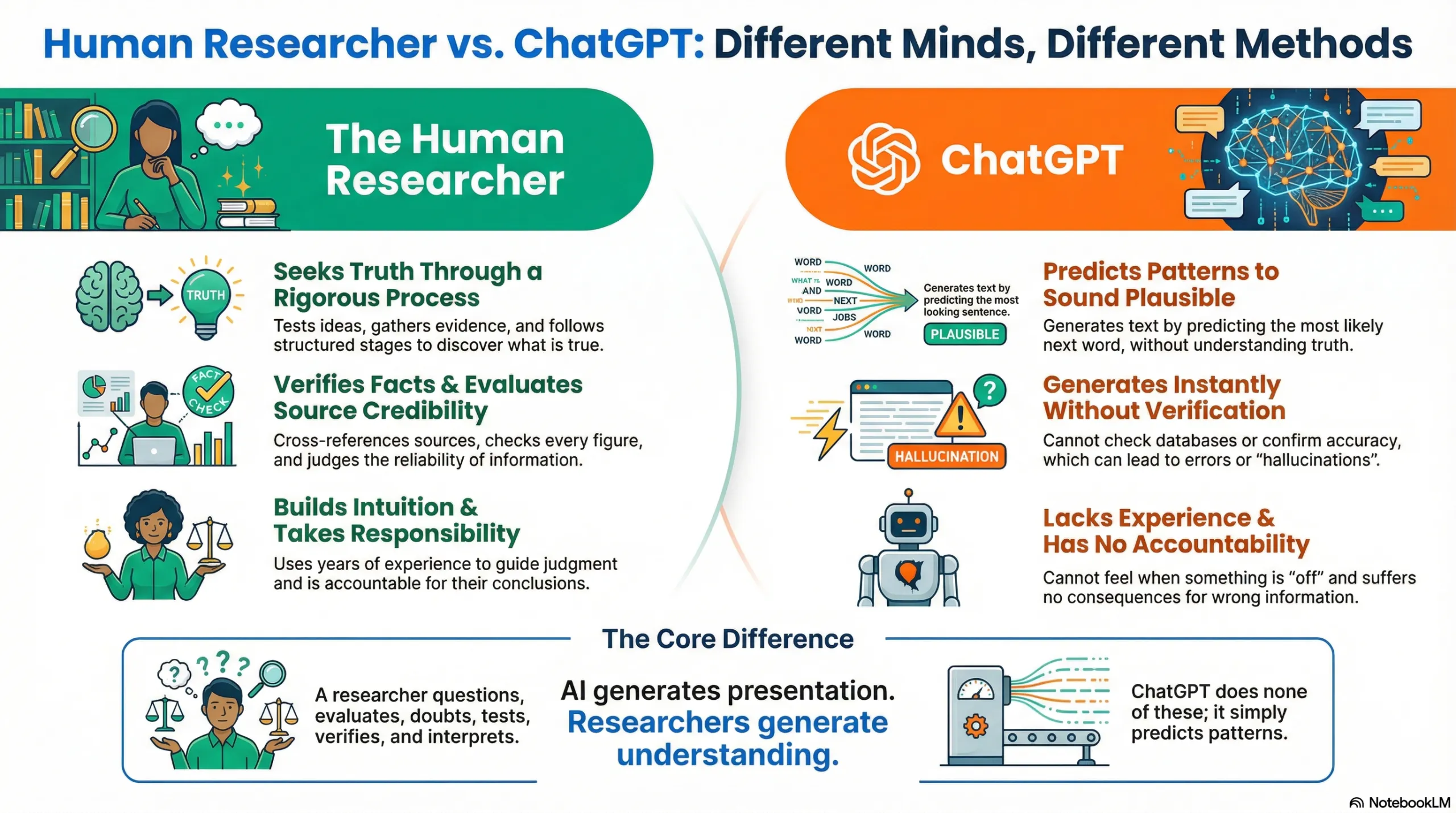
ChatGPT does not research. It predicts the next most probable word given everything it was trained on. That is a powerful capability — but it is synthesis, not inquiry. A human researcher works the other way around: starting from a question, gathering primary sources, testing claims against evidence, and only then writing a conclusion. Understanding the difference is the foundation of using AI safely in professional work.
ChatGPT: Probabilistic Synthesis
Generates language by statistical likelihood. Fast, broad, and articulate — but it cannot check a source, weigh evidence, or know when it is wrong. It has no access to what is true, only to what is likely to be said.
Human Researcher: Critical Verification
Frames questions, retrieves primary sources, cross-checks claims, and applies domain judgment. Slower — but every conclusion is traceable to evidence, and someone is accountable for the result.
Side-by-Side: How Each Approach Handles a Research Task
| Research Step | ChatGPT | Human Researcher |
|---|---|---|
| Framing the question | Accepts the prompt as given; mirrors its assumptions | Interrogates the question, scopes it, challenges bias |
| Finding sources | Cannot retrieve live sources; may invent citations | Searches databases, archives, and primary documents |
| Evaluating evidence | No mechanism for verification | Checks provenance, date, authority, and corroboration |
| Handling uncertainty | Answers with uniform confidence, right or wrong | Flags gaps, caveats, and conflicting evidence |
| Accountability | None — output carries no responsibility | Professional reputation stands behind every claim |
Where Each One Wins
ChatGPT excels at acceleration: brainstorming angles, summarizing material you provide, drafting structures, and explaining unfamiliar concepts in plain language. The human researcher excels at everything that determines whether the final product is true: source discovery, verification, contextual judgment, and the decision to publish or keep digging. The augmented researcher uses the machine for speed and reserves judgment for themselves.
The Professional Standard
AOFIRS teaches a simple rule: AI output is a lead, never a source. Every fact, quote, statistic, or citation produced by a language model must pass through human verification before it enters a professional deliverable. That discipline — not the tool — is what separates a researcher from a copyist.
Become a Certified Internet Research Specialist
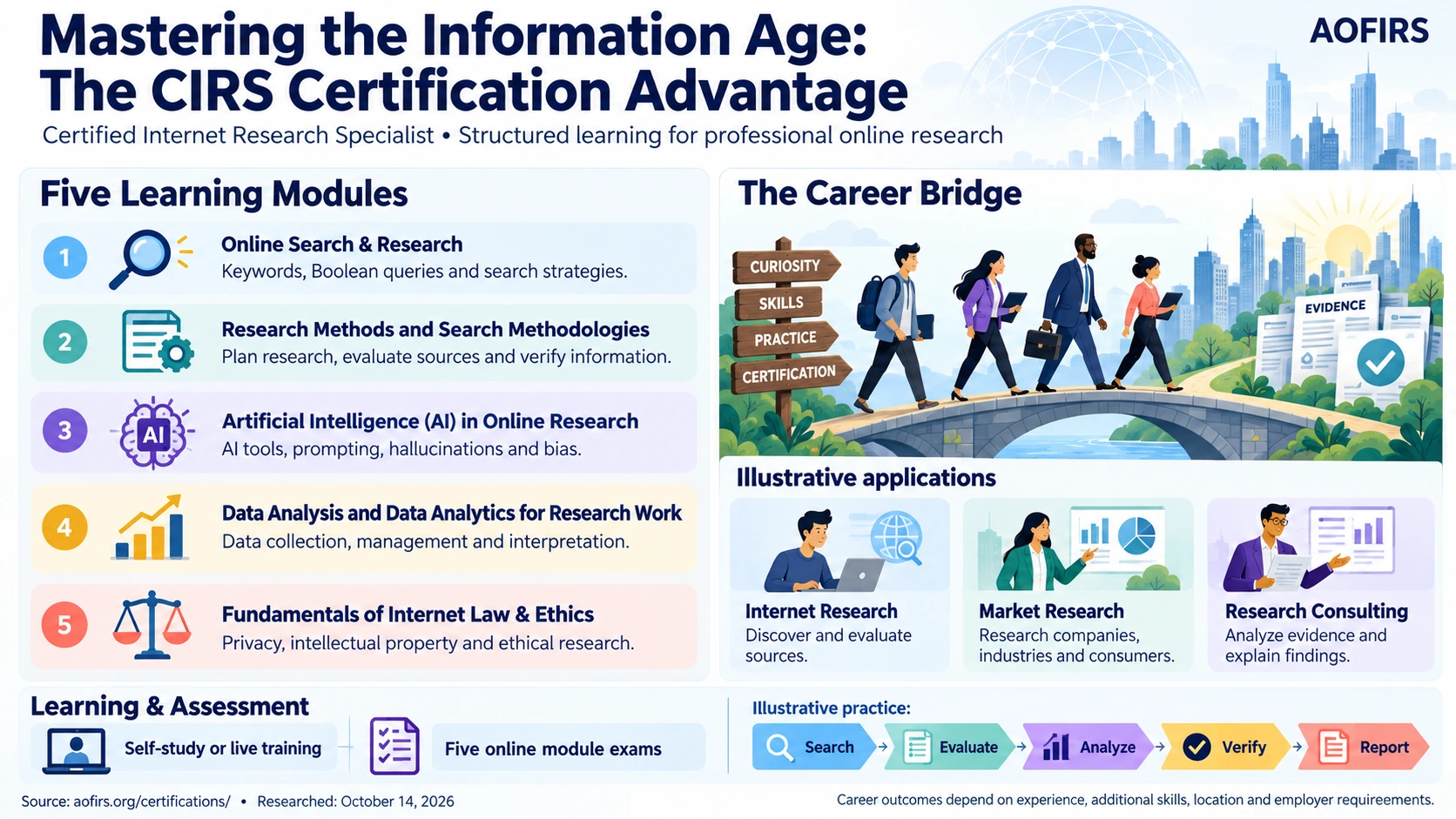
The CIRS Certification Course teaches the verification methods, search techniques, and AI-assisted workflows that define professional online research.
Frequently Asked Questions
Can ChatGPT replace a human researcher?
No. It can accelerate drafting and ideation, but it cannot verify sources, retrieve live information reliably, or take responsibility for accuracy. Professional research still requires human judgment at every step that determines truth.
Why does ChatGPT sometimes invent citations?
Because it generates text by probability, not retrieval. When asked for references it produces what a citation typically looks like — which may be a plausible-sounding source that does not exist. Always verify every citation independently.
What is the safest way to use ChatGPT in research?
Treat its output as a starting lead: use it for brainstorming, summarizing material you supply, and drafting structure — then verify every factual claim against primary sources before using it.
What skills does a human researcher have that AI does not?
Question framing, source provenance checking, corroboration across independent sources, recognition of bias and gaps, and professional accountability for the final product.
Does the CIRS course cover AI-assisted research?
Yes. The CIRS Certification Course includes modules on integrating AI tools into a verification-first research workflow, so you gain the speed of AI without inheriting its errors.