
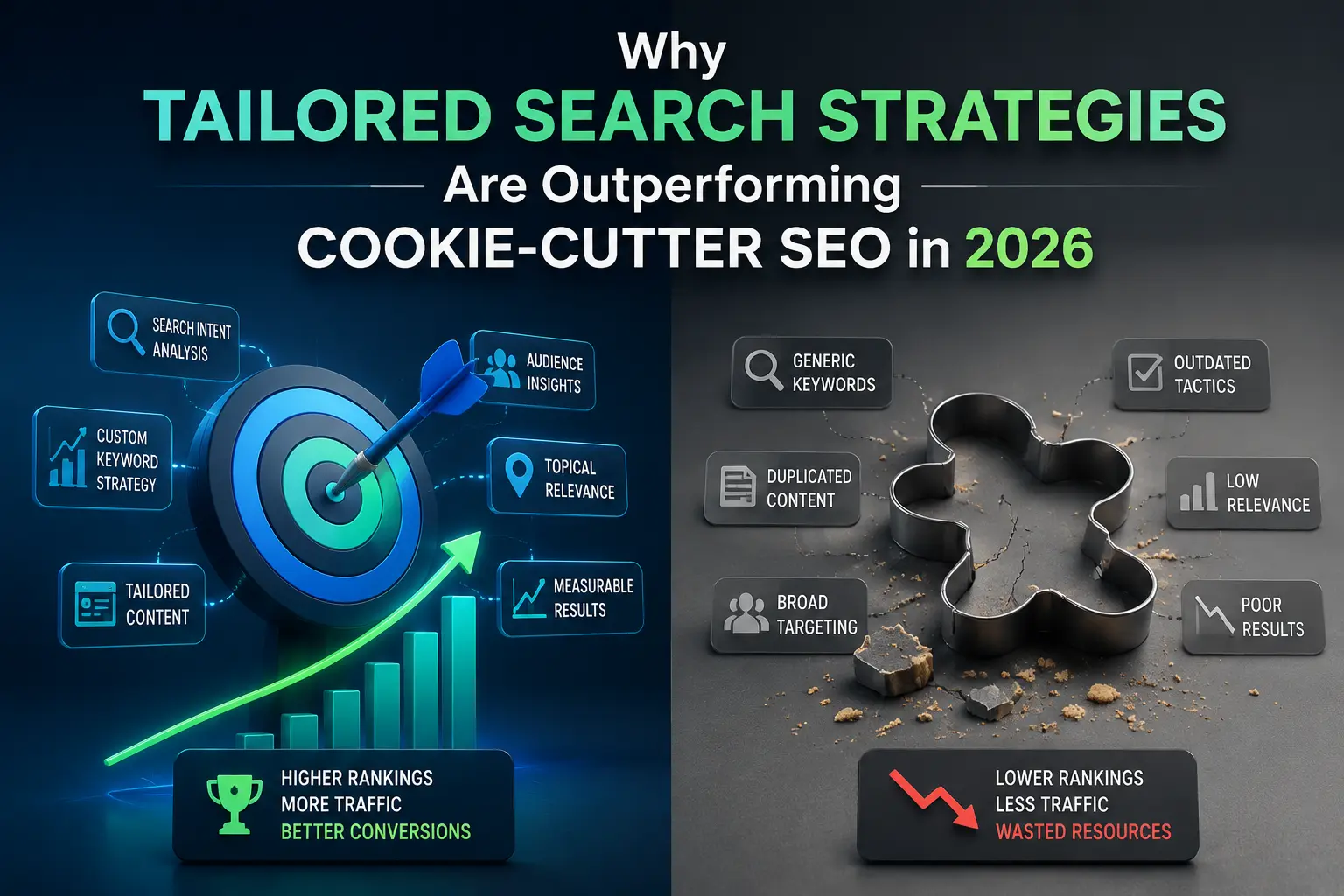

You’ve probably noticed that search results look different than they did even two years ago. AI-generated answers sit at the top of the page, queries are longer and more conversational, and the way visibility gets earned has shifted alongside that change. If you’ve worked with an SEO provider during this stretch, you’ve also likely seen the limits of the standard package approach: the same checklist, the same monthly deliverables, the same outcome regardless of what your business actually does. The agencies still relying on those templates are quietly falling behind, while the ones treating optimisation as a tailored discipline are pulling ahead. The shift is worth understanding before your next round of investment.
The cracks in the cookie-cutter model
Templated SEO packages were built for a different era of search. When ranking came down to keyword density and a basic checklist of on-page elements, a productised service could deliver acceptable results across a range of businesses. That era ended several years ago. Search engines now interpret meaning, context, and user intent in ways that make blanket optimisation strategies feel hollow.
The typical packaged service runs through a familiar list: keyword research using off-the-shelf tools, a fixed number of blog posts per month, generic meta tag updates, and a backlink quota delivered through the same outreach process for every client. The work looks busy from the outside. Results often plateau within months because nothing inside the package was shaped around what makes the business different. For a plumbing supplier, an allied health clinic, and a software platform, the same template will produce three underwhelming outcomes. Search rewards relevance, and relevance cannot be templated.
What “tailored” actually means in practice
The word tailored gets used loosely in marketing, often as a synonym for “we’ll do some work and call it custom.” A genuinely customised approach looks quite different in practice. It begins with the business itself: the model, the margins, the buying cycle, the customers who already convert well, and the ones the business wants more of. From there, the work shifts to the competitive landscape, the technical state of the site, and the gaps between current visibility and where it needs to be.
Only then does keyword research begin, and even that step is shaped by what was learned earlier. Content structure follows the same logic, with topic selection driven by the real search journeys of the target audience and the questions buyers actually ask. Technical priorities are set based on what the site needs, identified through proper audit work. The output looks like an evolving strategy informed by real data, with deliverables tied to genuine business outcomes.
Why local market context changes the strategy
Geography matters in SEO in ways that surface-level analysis often misses. Search behaviour shifts between cities. The competitive landscape in Brisbane looks different from Sydney or Melbourne, with different incumbents, different content depth, and different patterns of local intent. Generic keyword research applied across markets misses these variations and produces strategies that look reasonable on paper while underperforming once they hit a specific market.
A business serving Brisbane customers needs a strategy informed by Brisbane search behaviour, Brisbane competitors, and the specific industries and suburbs that drive its traffic. Working with a bespoke SEO agency in Brisbane brings that local insight directly into the strategy, with content and technical decisions shaped by what’s actually competing for visibility in the local market. The same logic applies wherever a business operates. Regional context determines which keywords are worth pursuing, which content angles resonate, and which competitor moves matter. A strategy built without that context is essentially guesswork dressed up as planning.
The role of technical and structural foundations
Customisation isn’t only about content. The technical layer of a site, often invisible to users, is where many templated services fall short. Site speed, structured data, internal linking, crawl efficiency, and mobile usability all need to be configured for the specific site, the specific platform, and the specific way the business serves its audience.
A site built on Shopify has different technical priorities than one built on WordPress, which in turn looks nothing like an enterprise system running custom infrastructure. A packaged audit might flag the same generic issues across all three, recommend the same fixes, and miss the structural problems that are actually limiting performance. The result is a long list of completed tasks alongside flat traffic numbers. Proper technical work begins with understanding the site, the stack it runs on, and the constraints it operates within. From there, the priorities can be set in a way that produces visible movement in results.
Measuring whether your strategy is genuinely tailored
A few signals indicate whether the work being done is genuinely customised. Reporting is the first place to look. Custom strategy produces reports framed around the goals that matter to the business, including conversion paths, revenue from organic traffic, and rankings for the keywords that actually move the needle. Generic reporting leans on vanity metrics like impressions and average position across all keywords, regardless of whether those keywords have any commercial value.
Strategic adjustments are another signal. If the work hasn’t evolved in response to performance data over six months, the strategy is probably running on autopilot. Genuine partnerships involve recalibration, with the approach shifting as new information comes in. Content quality also tells the story. Articles that reflect the industry’s actual language, address questions real buyers ask, and connect to the broader business strategy come from a different process than generic posts written to fill a quota. The output reflects the input.
- Templated SEO packages no longer keep up with search engines that interpret intent, context, and meaning
- A genuinely tailored strategy starts with the business and audience, then shapes keyword research, content, and technical work around those specifics
- Local market context shifts every layer of the strategy, from competitor analysis to content angles to keyword priorities
- Reports, ongoing strategic adjustments, and content quality reveal whether the work is customised or simply a template with a different logo