
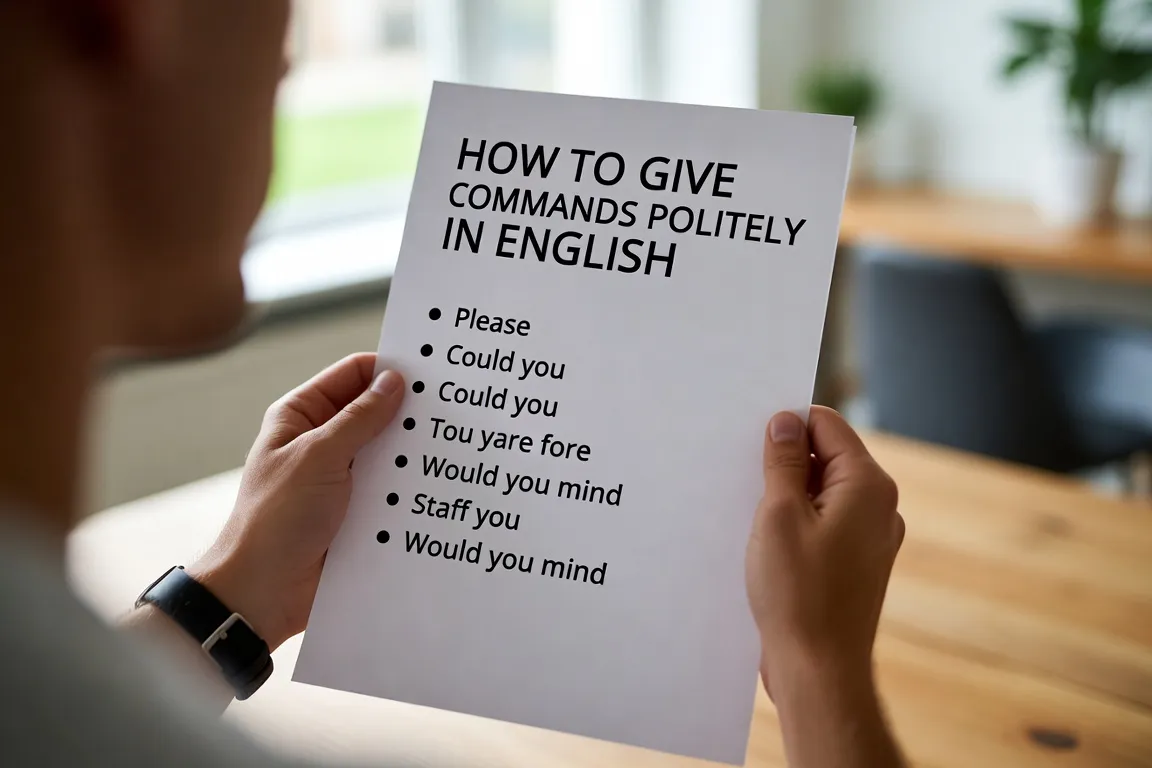
Even a brief English instruction that makes sense to you mentally could come across as too aggressive when spoken to someone else. You might say something like “Send me the file” or “Open the window,” but without malicious intent, you could be perceived as commanding and brusque.
Polite instructions are therefore very important. English imperatives are used in giving instructions, making requests, warning others and even giving advice, but context makes all the difference.
Start with the basic imperative form
Before you soften commands, you need to understand the basic form. An imperative usually starts with the base verb. The subject you is not written or spoken because it is already understood.
If you want to know how to form commands politely without sounding rude to native speakers, you can find clear examples of the imperatives at: https://learn.kotoenglish.com/grammar/general/imperatives/.
Basic imperatives are short:
Close the door.
Read the instructions.
Call me later.
Wait here.
Be careful.
These sentences are grammatically correct. The problem is not the grammar. The problem is the situation. A direct command can sound normal in a recipe, safety warning, classroom instruction or emergency. But in everyday conversation, work messages or customer service, it may need softer language.
Add please, but do not depend on it too much
The easiest way to make a command more polite is to add please. You can put please at the beginning or the end of a sentence.
Please send me the report.
Send me the report, please.
Please wait here.
Take a seat, please.
Both positions are correct, but the tone can feel slightly different. Please at the beginning, sounds clear and polite. Please at the end, can sound friendly, but it may also sound firm if the voice is sharp.
Compare:
Close the door.
Please close the door.
Could you close the door, please?
The first sentence is a direct command. The second is more polite because it includes please. The third sounds even softer because it uses a question form rather than a direct imperative.
Turn commands into polite questions
In English, polite commands often become questions. The grammar changes, but the meaning is still a request. This is common in offices, shops, classrooms, emails and everyday conversation.
Instead of:
Send me the link.
Say:
Could you send me the link?
Can you send me the link?
Would you send me the link when you have time?
Can you is common and friendly. Could you sound a little more polite. Would you can sound polite, but sometimes more formal.
For professional situations, could you + base verb is often a safe choice.
Could you check this document today?
Could you call the client after lunch?
Could you update the calendar?
These questions still ask someone to do something, but they do not sound like orders. They give the listener more space.
Use soft time phrases
A command can sound less rude when you add a polite time phrase. This works well when the task is not urgent.
Direct:
Reply to this message.
Softer:
Please reply when you have a chance.
Could you reply when you have a moment?
Please send it by Friday if possible.
Useful soft time phrases include:
- when you have a chance
- when you have a moment
- when possible
- by Friday, please
- before the meeting, please
- at your convenience
Be careful with at your convenience. It is polite, but it can sound formal. It works better in business emails than in casual messages.
A clear deadline can still be polite. You do not need to hide the real-time limit.
Could you send the final version by 3 p.m., please?
This sentence is polite because it uses could you, the base verb and please, but it is also clear.
Use would you mind for very polite requests
For extra polite requests, use would you mind + verb-ing. This form is useful when you ask someone to do something that may take effort or interrupt them.
Would you mind closing the window?
Would you mind checking this paragraph?
Would you mind waiting for a few minutes?
Notice the form after mind:
Correct:
Would you mind opening the door?
Incorrect:
Would you mind open the door?
After would you mind the -ing form should be used rather than the bare infinitive form. This structure sounds a little bit formal; however, it is very helpful in polite speech. Moreover, it will be helpful if you talk to a stranger.
You can answer in different ways:
Of course.
No problem.
Sure.
Not at all.
The phrase may look negative because of mind, but the meaning is polite. You are asking whether the action would be a problem for the listener.
Use let’s for polite group commands
When you include yourself in the action, use let’s + base verb. This form sounds more like a suggestion than an order.
Let’s start the meeting.
Let’s review the answers.
Let’s take a short break.
Let’s not talk over each other.
This is useful in group situations because it avoids making you sound like you are controlling everyone. You are suggesting a shared action.
Compare:
Start the meeting.
This sounds like an order.
Let’s start the meeting.
This sounds more cooperative.
You can make let’s even softer with a short question tag:
Let’s start with the first question, okay?
Let’s check the schedule first, shall we?
In American English, okay? sounds more natural in casual speech. Shall we? sounds more formal or slightly old-fashioned in many everyday situations, but it is still correct.
Use negative commands carefully
Negative imperatives usually start with don’t or do not.
Don’t touch that cable.
Don’t forget your passport.
Do not enter this room.
Do not share your password.
The basic negative form is don’t / do not + base verb. Negative commands can sound strong because they tell someone to stop or avoid an action. They are normal in safety rules, public signs and urgent warnings. In a personal conversation, you may want to soften them.
Direct:
Don’t be late.
Softer:
Please try to arrive on time.
Could you be here by 9?
Direct:
Don’t send the file yet.
Softer:
Please wait before sending the file.
Could you hold the file until I check it?
Sometimes a positive instruction sounds more polite than a negative imperative. Instead of saying what not to do, say what the person should do.
Choose a tone based on the situation
Politeness in English is based on the situation. You cannot address your friend, client, child, colleague, and stranger the same way.
When addressing friends, an imperatively worded short utterance would be appropriate:
Pass me your phone for a second.
Come here and look at this.
At work, a softer, polite request is usually safer:
Could you send me the updated file?
Please add the notes before the call.
With customers, politeness and clarity are both important:
Please enter your order number here.
Could you confirm your email address?
In emergencies, direct commands are better:
Call 911.
Move away from the road.
Do not touch the wire.
Politeness does not mean making every sentence long. It means choosing the right level of directness for the situation.
Common mistakes with polite commands
One common mistake is using please in a sentence that still sounds too direct in a formal situation.
Too direct:
Please give me your answer now.
Better:
Could you give me your answer today?
Another mistake is using question forms with the wrong word order.
Incorrect:
Could you to send me the file?
Correct:
Could you send me the file?
After could you, can you and would you, use the base verb.
Incorrect:
Would you mind send me the link?
Correct:
Would you mind sending me the link?
After would you mind, use the -ing form.
Learners also sometimes make polite requests too long. A sentence with too many soft phrases can sound unclear.
Too much:
I was wondering if maybe you could possibly send me the file when you perhaps have a little time.
Better:
Could you send me the file when you have a chance?
Good polite English is clear, not overly complicated.
Practice changing direct commands
The best way to learn polite commands is to rewrite direct sentences. Start with a simple imperative, then soften it.
Direct:
Open the document.
Polite:
Please open the document.
Could you open the document?
Would you mind opening the document?
Direct:
Wait outside.
Polite:
Please wait outside.
Could you wait outside for a moment?
Would you mind waiting outside?
Direct:
Check this message.
Polite:
Could you check this message when you have a chance?
Each of these types of commands has its own degree of politeness. There is no need to use the most polite one in all cases. It depends on the situation, person and goal.
Conclusion
It turns out that being polite in English does not mean saying please every time you give an order. It means using the appropriate type of command depending on the situation, your relationships with the addressee and the context.
Use please in case of ordinary courtesy, could you + base verb in case of normal polite commands, would you mind + verb-ing in case of extra polite commands and let’s + base verb in case of suggestion.