
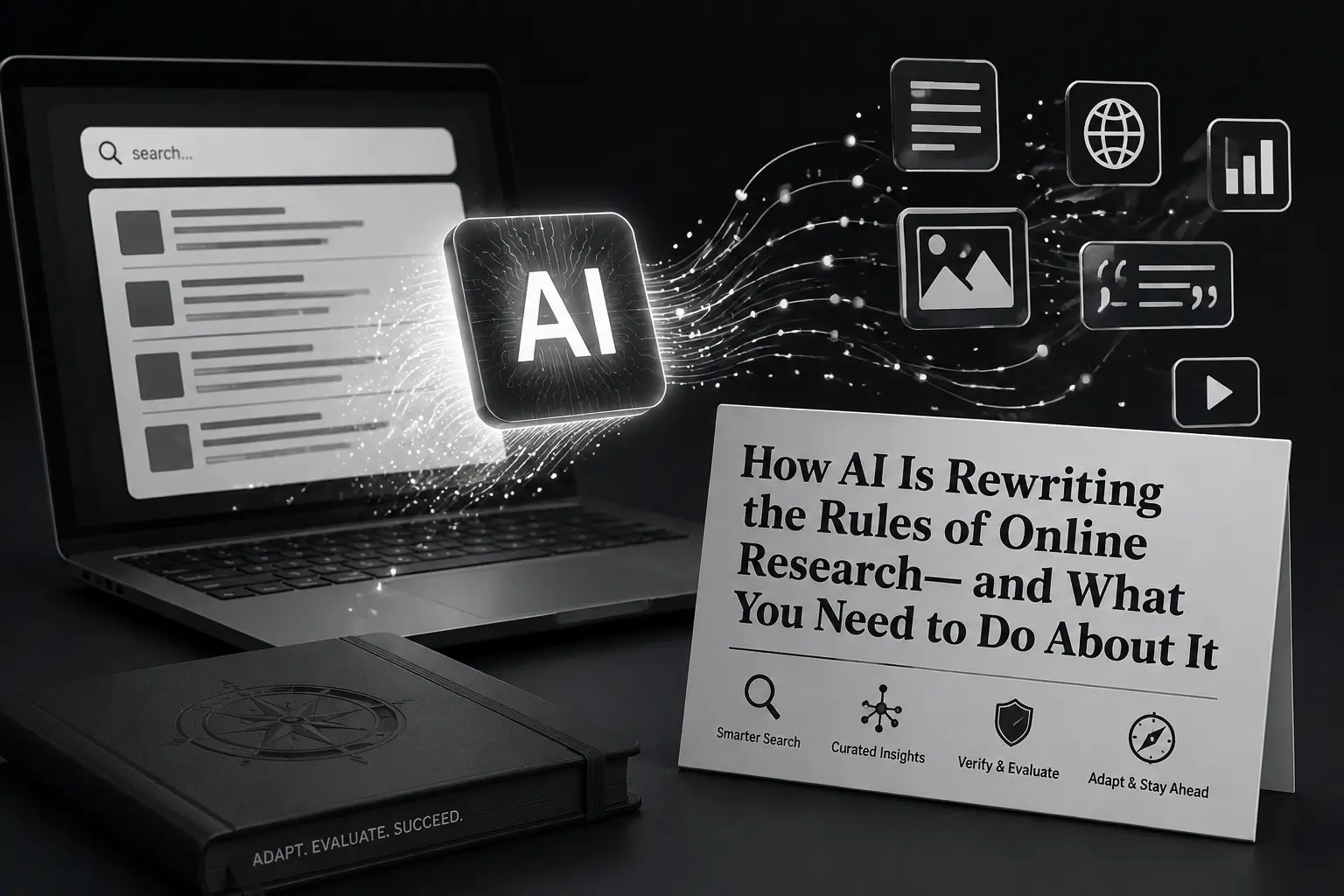
Think about the last time you searched for something online. Did you type a handful of choppy keywords and scan a list of blue links? Or did you ask a full question and receive a tidy, synthesized answer before you ever clicked anywhere? If it was the latter, you’ve already crossed a threshold that most people haven’t consciously noticed. The way we find information is undergoing its most fundamental transformation in over two decades and the vast majority of us are sleepwalking through it.
A comprehensive new User Guide from the Association of Internet Research Specialists (AOFIRS) examines what Google’s deep integration of artificial intelligence means for everyday users, researchers, content creators, publishers, and anyone who relies on the open web for knowledge. The picture it paints is genuinely fascinating and more than a little unsettling.
From Ten Blue Links to One Confident Answer
For roughly 25 years, searching online was a translation exercise. You had a complex, human question and your job was to compress it into the smallest possible string of keywords that a machine could parse. “Italian restaurant London.” “Headache fever remedy.” The results were a list of links to other people’s pages; your judgment did the rest.
That paradigm is over. Google’s redesigned search interface no longer asks you to fragment your thoughts. It now accepts full, natural language queries — and, increasingly, images, videos, audio, and uploaded documents as well. Google’s Head of Search, Liz Reid, has publicly noted that users are beginning to ask “the question they really have,” instead of translating it for machine consumption. This shift is called multimodal search, and it is already here.
What Multimodal Actually Means
Multimodal search allows users to combine different kinds of input in a single query. Photograph a plant and ask what it is. Upload a spreadsheet and ask questions about its contents. Record a voice note instead of typing. Submit a short video clip to diagnose a mechanical issue. Each of these was science fiction a few years ago; today, they are supported features.
The AOFIRS guide identifies five distinct dimensions through which users now interact with Google: natural language text, image input, video input, document and file input, and voice and audio. Where traditional search accepted only one (typed keywords), the new paradigm accepts all five simultaneously. The friction between “what I want to know” and “how I can ask it” has collapsed dramatically.
“Users are beginning to ask the question they really have — no longer fragmenting thoughts into keywords, but expressing full, nuanced queries in natural language.” — Liz Reid, Google’s Head of Search
But the shift runs deeper than just input types. The results themselves have changed. Where traditional search returned a ranked list of external links, AI-enhanced search returns what Google calls an “AI Overview” — a synthesized summary at the top of the page, generated by the AI from dozens of underlying sources. For many queries, users now receive a fully formed answer without ever leaving Google. Which brings us to the crisis that the people who make the internet are beginning to sound alarm bells about.
The Slow Death of the Click Economy
Here is a number worth sitting with: the entire ecosystem of online journalism, blogging, specialist publishing, and professional content creation is built on a single user action — the click. A reader searches on Google, sees a headline, clicks through to a website, and that visit generates advertising revenue. Multiply that by billions of daily queries and you have the economic engine of the modern web.
AI Overviews threaten that engine at its foundation. When a comprehensive, well-written summary appears before any external links, the incentive to click through to the source evaporates. The AOFIRS guide names this the “Google Zero” scenario: a future in which AI-driven searches progressively kill off web traffic, starving publishers, journalists, and content creators of the revenue they need to survive.
Who Gets Hurt?
The guide maps out the stakeholders at risk with uncomfortable precision. News publishers who rely on advertising and subscription revenue face dramatically reduced page visits. Online retailers whose sales depend on click-through purchases may find AI agents bypassing their product pages entirely. Content creators who earn from ad impressions face zero-click results that never expose their work to an audience. Advertisers in the cost-per-click model see fewer user-controlled search journeys. Even SEO professionals — the specialists whose entire career is built on understanding Google’s ranking signals — find their craft devalued as the old rules no longer apply.
Online news publishers, in particular, are describing this in survival terms. The phrase used in the guide is stark: some industry voices are calling it an “extinction-level event.” When readers get their answers served to them on the search page, the incentive to fund the journalists who dug up those answers in the first place begins to dissolve.
The Deeper Problem: Who Gets Credit?
Beyond the economics lies what the guide calls the “provenance problem.” When Google’s AI synthesizes an answer from dozens of sources, attribution can become partial, muddled, or absent entirely. A reader consuming an AI summary may have no clear sense of where the information originated — which publisher broke the story, which scientist conducted the research, which expert was quoted. The guide cites Sarah T. Roberts, Director of the Center for Critical Internet Inquiry at UCLA, who has observed that the algorithmic underpinnings of Google Search have always been opaque to end users. AI layers do not solve that opacity they compound it.
There is also the issue of accuracy. AI systems, including those powering Google’s Overviews, are capable of producing confident but factually wrong responses a phenomenon known as “hallucination.” One widely shared example involved Google’s AI recommending that users add glue to pizza as a culinary technique, sourced from a satirical Reddit post. The incident was absurd enough to be funny. But for publishers operating in medicine, law, finance, and science fields where reputations rest on accuracy the prospect of AI confidently misrepresenting their work is no joke at all.
The Agent in the Room: Who Is Actually Making Your Choices?
The transformation doesn’t stop at search results. Google is now rolling out what it calls “agentic” functionality — the capacity for search to perform tasks autonomously, over time, on a user’s behalf. You can instruct Google to monitor theatre ticket prices and alert you when they drop. You can ask it to scan for local events every week. You can set it loose to find the best deal on a product and come back when it’s found one.
This represents a profound expansion of Google’s role. Where search used to sit at the start of a research journey, agentic AI can now accompany you all the way through to a purchasing decision — acting as researcher, comparator, and potentially transaction facilitator, all at once. That sounds extremely convenient. It also raises questions that deserve serious attention.
The Invisible Hand
Independent technology analyst Carolina Milanesi has articulated the central concern clearly: the traditional search experience gave users a sense of control. You received options; you chose a path. The AI-driven model disrupts that dynamic in ways that are easy to miss. When you ask an AI agent to find you a pair of trainers, it may return a single recommendation. What you cannot easily determine is whether that recommendation reflects the genuinely best available option, a sponsored placement, or an algorithmically weighted preference based on factors you were never told about.
“If you’re going to say: ‘I want a pair of Jordans, go find them,’ you’re not necessarily sure what steps have been taken and whether the AI has used a source or a store that was paid for.” — Carolina Milanesi, Technology Analyst
The guide maps this out in a framework it calls the Opacity Problem. In traditional search, source URLs were clearly visible, sponsored results were clearly labelled, and users could choose from multiple competing options. In AI-driven search, sources are synthesized and may be obscured, advertising can be integrated into recommendations rather than separated from them, and the visible universe of choices is filtered before you ever see it. The guide rates user control, source transparency, and advertising disclosure all as “high risk” in the new environment.
Layered on top of all this is a profound asymmetry of information. As Liz Reid has noted publicly, natural language queries give Google far greater insight into user intent — including when a user shifts from researching a product to being ready to buy it. That precision enables more targeted advertising. The irony is that users get less clarity about why they’re seeing what they’re seeing, precisely at the moment Google understands them better than ever before.
Researching in the Age of AI: A New Discipline
None of this is an argument for abandoning AI-powered search. The speed, richness, and intuitive ease it offers are real advantages — especially for exploratory research and rapid orientation in unfamiliar territory. The argument, rather, is for using it with clear eyes and deliberate habits. The AOFIRS guide proposes a practical framework called SMART-M for navigating the new landscape.
The SMART-M Framework
The six principles of SMART-M are worth committing to memory:
- Source Verification: Always identify the primary source behind any AI summary. Follow citation links. Cross-check with original publications.
- Multimodal Input: Use the full range of available input types — images, files, voice queries — to refine and enrich your searches beyond what text alone can capture.
- Adversarial Questioning: Actively challenge AI-generated answers. Ask follow-up questions like “What are the counterarguments?” or “What are the limitations of this view?” Don’t let confident prose be mistaken for complete truth.
- Recency Check: AI models have knowledge cutoffs and may synthesize older content without making its age apparent. Use date filters and seek out updated databases, especially for fast-moving topics.
- Triangulation: Confirm key findings across three or more independent sources before treating anything as settled. Never rely on a single AI summary for a critical decision.
- Meta-Awareness: Understand the incentives shaping your results. Recognize ads, sponsored placements, and algorithmically weighted recommendations for what they are.
Lateral Reading: The Fact-Checker’s Secret
Perhaps the most immediately practical technique the guide recommends is lateral reading — a method used by professional fact-checkers to assess the credibility of a source before reading it in depth. Instead of diving into a source straight away, you open multiple tabs and search for what others say about it. Is this organization reputable? Do independent experts cite it? Has it been criticized for bias or inaccuracy? In the age of AI, where unfamiliar sources can appear in synthesized summaries without context, this habit is more important than ever.
Go Beyond the Overview — Every Time
The guide is unambiguous on one point: AI Overviews are starting points, not conclusions. For any research that matters — medical, legal, financial, scientific, journalistic — the overview should function like an abstract rather than a paper: useful for orientation, not sufficient for decision-making. The real work happens when you identify the cited sources, visit the original publisher websites, cross-reference with academic databases, and synthesize the findings yourself.
That final step — synthesizing independently — is not just a quality-control measure. It is how genuine understanding is built. When you write your own summary of what you’ve found, you force active engagement with the material. You notice gaps and contradictions. You form your own analytical judgment rather than inheriting an algorithm’s curation choices. That distinction, the guide argues, is exactly what separates an informed researcher from a passive consumer of AI-generated content.
The Skill Nobody Is Teaching — But Everyone Needs
We are at an inflection point in the history of information access. The convenience that AI-powered search offers is genuine and, for many purposes, transformative. Natural language queries remove the friction of keyword distillation. Multimodal inputs let us search the way we actually experience the world. AI Overviews surface relevant answers in moments.
But convenience is not the same as comprehension. The very fluency that makes AI search feel natural also makes it easy to accept its outputs uncritically. When a search engine presents a confident, well-structured answer, the cognitive cue to question it, verify it, and explore further is diminished. The AOFIRS guide is unsparing about what that means: without active effort, we risk becoming passive consumers of algorithmically curated information rather than genuinely informed thinkers.
The three risks the guide identifies — reduced publisher viability, diminished consumer agency, and system opacity — are not separate problems. They are interconnected dimensions of a single shift in the power dynamics of information. The economic pressure on publishers threatens the quality and diversity of the information that feeds the AI systems themselves. The reduction of user choice makes us more dependent on algorithmic judgment at precisely the moment that judgment is least transparent. And the opacity of AI reasoning makes it harder to know when we’re being served a fact, an inference, a sponsored result, or a hallucination.
The ability to navigate AI-powered search effectively — to use its strengths without being misled by its limitations — is one of the most valuable intellectual skills of our time.
The researchers, analysts, students, and professionals who will thrive in this environment are not those who distrust AI search — nor those who trust it uncritically. They are those who understand it well enough to use it as a powerful assistant while maintaining the intellectual habits that no algorithm can replace: curiosity, scepticism, lateral reading, source verification, and independent synthesis.
You don’t Google like you used to. The question is whether you’re searching more effectively — or just more comfortably.
Sources & Further Reading
Primary source: “The New Era of Search: Navigating Google’s AI Transformation” — Association of Internet Research Specialists (AOFIRS), Naveed Manzoor, May 10, 2026.
Additional citations: Google I/O 2025 announcements; Center for Critical Internet Inquiry, UCLA (Sarah T. Roberts); Carolina Milanesi (Independent Technology Analyst); NPR Technology Desk.