Contents
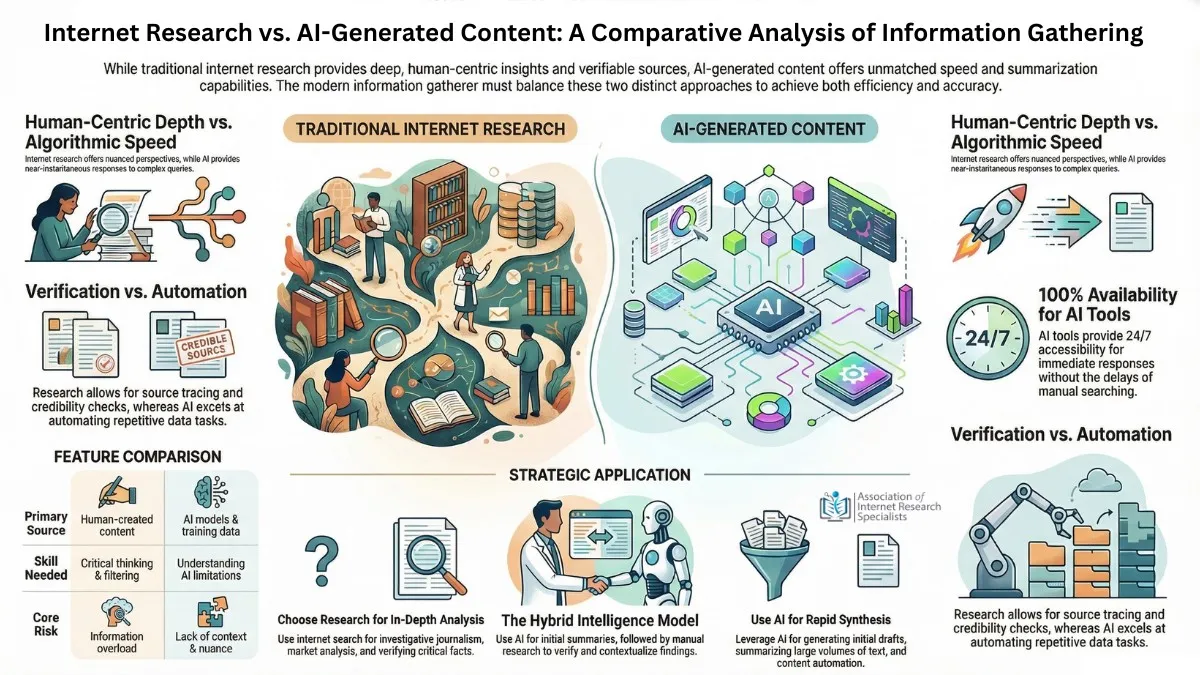
Researching information on the Internet and using AI-generated content are two distinct approaches to gathering and generating information, each with its own advantages and disadvantages. Below is a detailed comparison of the two:
Research for Information on the Internet
Advantages:
- Access to Diverse Sources: The Internet provides access to a vast array of sources, including academic papers, news articles, blogs, forums, and government publications. This diversity allows for a well-rounded understanding of a topic.
- Up-to-Date Information: The Internet is constantly updated, making it easier to find the latest information, trends, and developments in real-time.
- Credibility Verification: Users can cross-check information from multiple sources to verify its accuracy and credibility.
- Human-Centric Insights: Content created by humans often includes personal experiences, opinions, and nuanced perspectives that AI may not fully capture.
- Transparency: Sources are usually cited, allowing users to trace the origin of the information and evaluate its reliability. {module Banner In-article Ad}
Disadvantages:
- Time-Consuming: Sifting through large amounts of information to find relevant and reliable data can be time intensive.
- Information Overload: The sheer volume of content online can be overwhelming, making it difficult to identify high-quality information.
- Bias and Misinformation: Not all online sources are reliable. Users must critically evaluate content to avoid bias, misinformation, or outdated information.
- Skill-Dependent: Effective research requires skills in filtering, analyzing, and synthesizing information, which not everyone possesses.
Using AI-Generated Content
Advantages:
- Speed and Efficiency: AI can generate content or provide answers almost instantly, saving significant time compared to manual research.
- Summarization: AI tools can condense large volumes of information into concise summaries, making it easier to grasp complex topics quickly.
- 24/7 Availability: AI tools are always accessible, providing immediate responses to queries without delays.
- Customization: AI can tailor responses to specific queries, offering personalized insights based on user input.
- Automation: AI can automate repetitive tasks like data analysis, report generation, or content creation, freeing up time for more strategic work.
Disadvantages:
- Lack of Context and Nuance: AI-generated content may lack the depth, context, or nuanced understanding that human-created content provides.
- Accuracy Issues: AI models can produce incorrect or outdated information, especially if they rely on incomplete or biased training data.
- Over-Reliance on Training Data: AI-generated content is only as good as the data it was trained on. If the training data is limited or biased, the output may reflect those limitations.
- Ethical Concerns: AI-generated content raises questions about plagiarism, intellectual property, and the potential for misuse (e.g., generating fake news or misleading information).
- Impersonal Tone: AI-generated content may lack the emotional or creative touch that human writers bring, making it less engaging for certain audiences.
Key Differences Between the Two Approaches
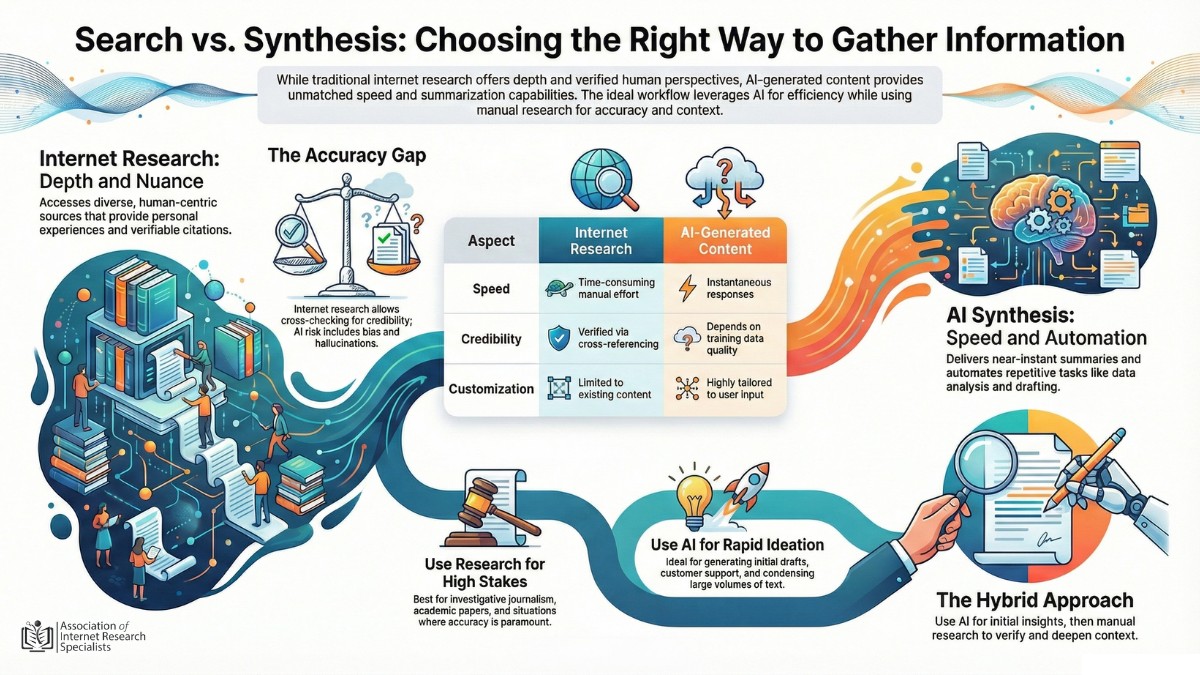
Comparision between Internet Research and AI Generated Content
| Aspect | Internet Research | AI-Generated Content |
| Source of Information | Human-created content from diverse sources. | Generated by AI models based on training data. |
| Speed | Time-consuming due to manual effort. | Instantaneous or near-instant responses. |
| Depth of Insight | Offers nuanced, human-centric perspectives. | May lack depth or context. |
| Credibility | Can be verified through cross-referencing. | Depends on the quality of training data. |
| Customization | Limited to available content. | Highly customizable based on user input. |
| Bias and Misinformation | Risk of bias or misinformation in sources. | Risk of bias or inaccuracies in training data. |
| Skill Requirement | Requires research and critical thinking skills. | Requires understanding of AI limitations. |
When to Use Each Approach
Internet Research:
- Best For: In-depth analysis, verifying facts, exploring diverse perspectives, and understanding complex or nuanced topics.
- Use Cases: Academic research, investigative journalism, market analysis, or when credibility and accuracy are paramount.
AI-Generated Content:
- Best For: Quick answers, summarizing information, automating repetitive tasks, and generating initial drafts or ideas.
- Use Cases: Content creation, customer support, data analysis, or when speed and efficiency are critical. {module Banner In-article Ad}
Conclusion
Both Internet research and AI-generated content have their place in the information-gathering process. Internet research is ideal for thorough, credible, and nuanced insights, while AI-generated content excels in speed, efficiency, and automation. The best approach often involves combining the two: using AI to quickly generate initial insights or summaries, followed by manual research to verify, contextualize, and deepen the understanding of the topic.
By leveraging the strengths of both methods, users can achieve a balanced, efficient, and reliable approach to information gathering and content creation.