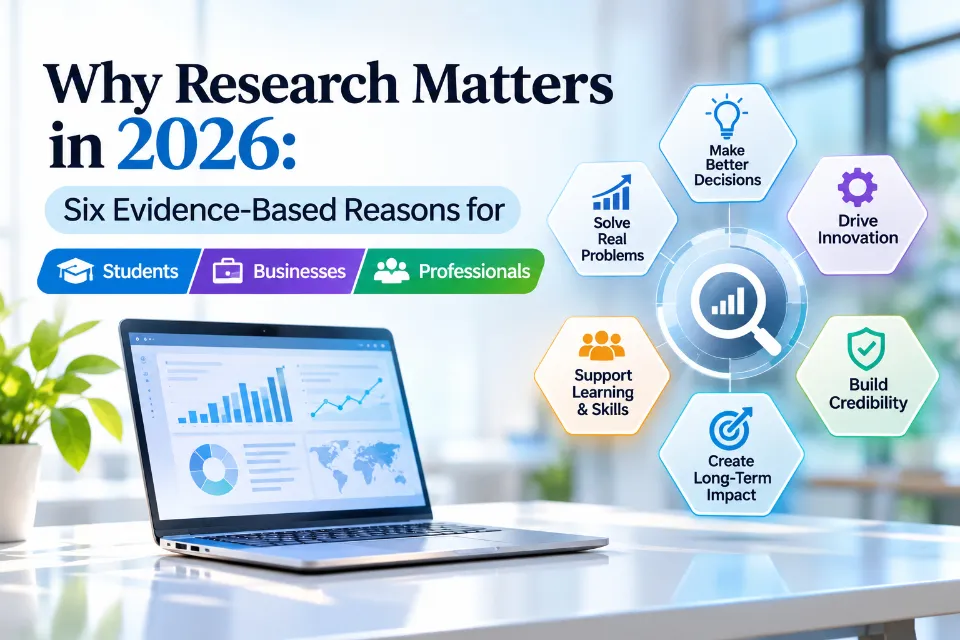
From a student choosing a thesis topic to a founder testing a product idea, most consequential decisions depend on research. In 2026 that research involves search engines, databases, data analysis, AI assistants and, above all, judgment about what to believe. This article sets out six reasons research matters, draws on published evidence, and ends with practical techniques you can apply straight away.
What research means in practice
Research is the structured process of collecting, verifying and analyzing information to understand a topic, solve a problem or make a decision. It is not limited to academics: students, business owners, analysts, entrepreneurs and public-sector decision-makers all rely on the same basic cycle. You frame a question, search for relevant sources, judge their reliability, check important facts against independent evidence, analyze what you found and record how you reached your conclusion.
The steps matter more than the tools. A well-framed question and a disciplined verification habit will outperform a powerful search tool used carelessly. AOFIRS covers the underlying skills in more detail in essential student research skills.
- 1. Question
- 2. Search
- 3. Evaluate
- 4. Verify
- 5. Analyze
- 6. Apply and document
Apply and document → Refine the question → Repeat the cycle
Why research matters more in the AI era
Three developments make careful research more valuable now than a decade ago.
- False news spread faster in a major Twitter study. A study of about 126,000 news stories shared on Twitter between 2006 and 2017 found that false stories spread farther, faster and more broadly than true ones. Automated accounts spread true and false news at similar rates, so the difference came from people sharing false stories (False news diffusion study).
- AI tools can invent sources. When researchers asked ChatGPT to write short literature reviews, about 55% of the citations produced by GPT-3.5 and 18% of those produced by GPT-4 referred to works that do not exist (AI citation accuracy study). These figures describe the study’s 2023 test and model versions, not the error rates of current systems. For a method to check AI output, see verify AI answers and citations.
- Synthetic content is growing. NewsGuard, which monitors news sites, had identified 3,749 “AI content farm” sites by 23 June 2026: sites that publish mostly AI-generated content with little human oversight and without disclosing it (NewsGuard AI tracking).
Together these trends shift the hard part of research from finding information to deciding which information is trustworthy. AOFIRS compares the two approaches in research versus AI-generated content.
Six reasons research is important
1. Research replaces assumptions with reliable knowledge
Even published findings can be less solid than they appear. In a large collaborative project, researchers repeated 100 experimental and correlational studies published in three psychology journals, using larger samples and the original materials where available. Of the original studies, 97% had reported statistically significant results; only 36% of the replications did, and replication effects were on average about half the size of the originals (Psychology replication study).
The lesson is not that research is unreliable. It is that one source is rarely enough. Before you rely on a finding, look for replications, systematic reviews or meta-analyses on the same question, and note whether the result has been tested by independent teams.
2. Research makes problem-solving systematic
Structured research gives you a repeatable way to work through academic, workplace or business problems instead of reacting to the most visible symptom. A simple sequence works for most problems:
- Define the problem precisely, including what a good outcome looks like.
- Analyze likely causes and separate them from symptoms.
- Review the available evidence on each cause.
- Evaluate possible solutions against that evidence and their costs.
- Monitor the outcome and revisit the analysis if results differ from expectations.
Writing each step down, even briefly, makes your reasoning visible to colleagues and easier to correct later.
3. Research keeps your information current and trustworthy
Information changes quickly, and outdated figures are a common source of errors in reports and presentations. Credible databases, official statistics, academic journals and established publishers reduce that risk, but only if you check them properly. For each important source, confirm:
- when it was published or last updated, and whether a newer edition exists;
- who produced it and whether they have a stake in the conclusion;
- whether the figures trace back to an original dataset you can open.
Specialized search tools help you reach primary material faster than a general web search. AOFIRS maintains a library of specialized search tools and a list of academic search engines.
4. Research builds credibility
Readers, examiners, clients and managers trust work that shows its evidence. Whether you are writing an academic paper, publishing an article or presenting a business case, credibility comes from three habits: citing sources a reader can check, presenting data rather than assertions, and explaining how you reached your conclusion.
The rise of AI drafting tools makes the first habit essential. Because chatbots can produce plausible references to papers that do not exist (AI citation accuracy study), confirm every citation by opening the source itself, ideally through its DOI or the publisher’s page, before it goes into your work.
5. Research reduces business risk
Market research is often presented as a growth tool, but its main value is avoiding expensive mistakes. CB Insights analyzed 431 venture-backed companies that shut down since 2023 and identified failure reasons for 385 of them. Running out of capital was cited in 70% of cases, though the report notes this is usually the final cause rather than the root problem. Poor product-market fit was cited in 43%, bad timing or macro conditions in 29% and unsustainable unit economics in 19%; many companies had more than one reason (CB Insights startup analysis). These percentages concern the 385 classified shutdowns, not the failure rate of all startups.
Several of those causes can be tested with research before money is spent:
- Customer research: interviews and surveys that test whether the problem you plan to solve is real and urgent for a defined group.
- Competitor analysis: what exists already, at what price, and why customers would switch.
- Desk research: official statistics, industry reports and regulatory filings that size the market and flag constraints.
None of these guarantees success, but each turns an assumption into evidence you can act on.
6. Research supports career development
Research skills are in demand as a profession and as a general workplace skill. The U.S. Bureau of Labor Statistics reports a median annual wage of $78,760 for market research analysts in May 2025 and projects employment growth of 7% from 2025 to 2035, faster than the average for all occupations, with about 82,000 openings a year (BLS market research data). Pay and demand vary by country, sector and experience.
Beyond dedicated research roles, employers rank analytical thinking as the most important core skill: seven in ten employers surveyed for the World Economic Forum’s Future of Jobs Report 2025 consider it essential. The same report expects about 39% of workers’ existing skills to be transformed or become outdated between 2025 and 2030 (Future of Jobs report). The ability to find, evaluate and apply new information helps people adapt to that change. AOFIRS describes the career routes in becoming an internet researcher.
How to improve your research skills
1. Start with a broad overview
Use general sources such as encyclopedias, textbooks or review articles to learn the vocabulary and main debates of a topic. Then move to specialized databases, where precise terms return better results.
2. Use credible sources
Ask four questions of every source:
- Is the author qualified to write on this subject?
- Is the information supported by evidence you can check?
- Is the publisher or institution reputable?
- Is there a potential bias or conflict of interest?
Academic journals, government publications and established institutions are usually reliable starting points, but they still need the same questions.
3. Verify information against independent sources
Professional researchers do not rely on a single source for an important fact. Confirm it with at least one independent source, ideally the original dataset or document. Two articles that copy the same press release count as one source, not two.
4. Stay organized
Organized notes save time and protect you from accidental plagiarism. Useful tools include a reference manager to store citations, a research log that records the searches you ran and what they found, and a simple spreadsheet that tracks each source, its date and how you verified it. Browser bookmarks and a running bibliography work for smaller projects.
5. Learn advanced search techniques
Four techniques make the biggest difference to search quality:
- Boolean search: combining terms with AND, OR and NOT to control precision and recall.
- AI-assisted research: using AI to plan searches and summarize material you have already retrieved, then checking its output.
- Deep web research: searching databases and archives that general search engines do not index.
- Data verification: tracing figures to their original source and checking how they were produced.
A note on structured training
Readers who want formal training can review the AOFIRS CIRS certification program, alongside other courses offered by universities and professional bodies.
Conclusion
Research matters because decisions made on weak evidence are expensive, whether the cost is a failed product, a retracted claim or a lost argument. The evidence above shows why: single studies often fail to replicate, false information spread faster in the Twitter study, and AI tools can invent sources. Researchers who frame clear questions, verify what they find and document their method produce work that others can trust and build on.
References
- CB Insights. (2026, March 5). The top 9 reasons startups fail. CB Insights startup analysis
- NewsGuard. (2026). AI tracking center [Web page, last updated June 23, 2026]. NewsGuard AI tracking
- Open Science Collaboration. (2015). Estimating the reproducibility of psychological science. Science, 349(6251), aac4716. Psychology replication study
- U.S. Bureau of Labor Statistics. (2026, August 27). Market research analysts. In Occupational outlook handbook. BLS market research data
- Vosoughi, S., Roy, D., & Aral, S. (2018). The spread of true and false news online. Science, 359(6380), 1146–1151. False news diffusion study
- Walters, W. H., & Wilder, E. I. (2023). Fabrication and errors in the bibliographic citations generated by ChatGPT. Scientific Reports, 13, 14045. AI citation accuracy study
- World Economic Forum. (2025, January 7). The future of jobs report 2025. Future of Jobs report