Reconnecting with a classmate, former colleague or childhood friend usually starts with a name and a few remembered facts: a school, a town, a workplace, a rough age. Many online services promise to turn that into a phone number or address. Some are free and built for reconnection, such as school directories, genealogy records and social networks. Others are commercial data brokers that sell reports compiled from public records and other sources.
This guide sets out a method that starts with free sources, which leave the other person in control of whether to reply, and only then turns to paid people-search sites. It explains the legal limits on how those sites may be used, compares 15 options, including services whose full reports require payment, and shows how to remove your own information. For a broader list of people-search engines, see our people-search tools guide. For how professionals check whether a result is the right person, see the people-search verification guide.
Law and Ethics Before Searching
This is general information, not legal advice. Searching, collecting, sharing, and using personal information may be regulated differently by location and purpose. Free access does not create unrestricted permission to use the information.
- Eligibility screening limits. In the United States, the Fair Credit Reporting Act (FCRA) controls “consumer reports” used to decide eligibility for credit, insurance, employment, certain government license or benefit decisions and other specified purposes. Those reports may be furnished only for a permissible purpose listed in the Act (FCRA permissible purposes). Many people-search services disclaim consumer-reporting-agency status, but a disclaimer alone does not determine their legal obligations. Spokeo’s site, for example, states that it is not a consumer reporting agency under the FCRA and must not be used for decisions about credit, employment or tenant screening (Spokeo). Never use these reports to screen a tenant, an employee or a borrower. Use an FCRA-compliant background-check provider instead (see the criminal-record research guide).
- The FTC enforces these limits. In 2012 Spokeo agreed to pay $800,000 to settle FTC charges that it marketed profiles to employers and recruiters without following the FCRA (Federal Trade Commission, 2012). In 2023 TruthFinder and Instant Checkmate agreed to pay $5.8 million over FTC allegations that they marketed reports for employee and tenant screening while disclaiming FCRA status, and made misleading claims about accuracy (Federal Trade Commission, 2023).
- Outside the U.S. Most of these aggregators cover U.S. records. In the European Union and the UK, personal data is protected under the General Data Protection Regulation (GDPR) and the UK GDPR, which give people rights such as erasure and objection (GDPR). Those rights have conditions and exceptions; the scope of data-protection law, including personal or household exceptions, depends on the activity. Public availability does not eliminate privacy obligations.
- Respect a choice not to be found. Someone who has moved, changed their name or left social media may have done so deliberately. Never use people-search results to turn up uninvited at a home or workplace, to contact someone who has asked not to be contacted, or to locate a person for anyone else’s harassment.
How People-Search Sites Work
People-search sites compile records about individuals into profiles: names and aliases, past addresses, phone numbers, relatives and associates, and, on some sites, court and property records. Their data comes from public records and other third-party sources. The FTC’s 2023 complaint against TruthFinder and Instant Checkmate alleged that the companies did not verify the third-party data they used (Federal Trade Commission, 2023). Treat any report as a set of leads, not facts, and confirm the person’s identity before contacting anyone.
How to Use This Comparison
This is a source-based directory, not an accuracy ranking or a test of paid reports. No searches on real people or report purchases were performed for this revision. The table distinguishes source types, likely costs, and practical limitations; availability, plan features, and prices can change. Before paying, read the checkout price, renewal terms, cancellation process, and permitted uses. A free search or preview does not mean a full report is free.
15 Reconnection Options Compared
| Tool | Category and cost | Best starting use | Limits to check |
|---|---|---|---|
| Social network; basic account free | Mutual contacts and remembered schools or towns | Privacy settings, filters, and message access vary | |
| Professional network; free and paid accounts | Former employers, schools, and colleagues | Search and messaging limits depend on account | |
| Classmates | School directory; free and paid features | School, graduation year, and reunion leads | Confirm which features require membership |
| FamilySearch | Nonprofit genealogy service; free account options | Historical records and family context | Records and access restrictions vary; not a current contact directory |
| Community platform; basic use free | Public alumni or community reunion discussions | Follow community rules; never post private contact details | |
| Legacy.com | Obituary directory; browsing options | Historical names and family context | Coverage is incomplete; approach bereavement information sensitively |
| Wayback Machine | Web archive; free | Older school, club, or employer pages | Archived details can be stale or missing |
| Spokeo | Commercial aggregator; full reports paid | Possible identity or location leads | Check plan scope, renewals, permitted use, and opt-out |
| PeopleFinder | Intelius-powered commercial aggregator | Name, phone, or address leads | Site prohibits covered eligibility screening |
| US Search | Commercial aggregator | Possible U.S. public-record leads | Confirm pricing, current features, and privacy request route |
| BeenVerified | Commercial aggregator | Possible U.S. public-record leads | Confirm plan coverage and cancellation; verify every match |
| Whitepages | Directory and commercial reports | Possible phone or address leads | Free results and paid report content differ |
| ZabaSearch | Directory and commercial report referrals | Possible U.S. name and contact leads | Confirm what is free and which provider supplies paid results |
| TruthFinder | Commercial background-style reports | Leads only; not verified findings | Check terms and privacy process; note FTC enforcement history |
| Instant Checkmate | Commercial background-style reports | Leads only; not verified findings | Check renewals and permitted use; note FTC enforcement history |
Start With Free Sources
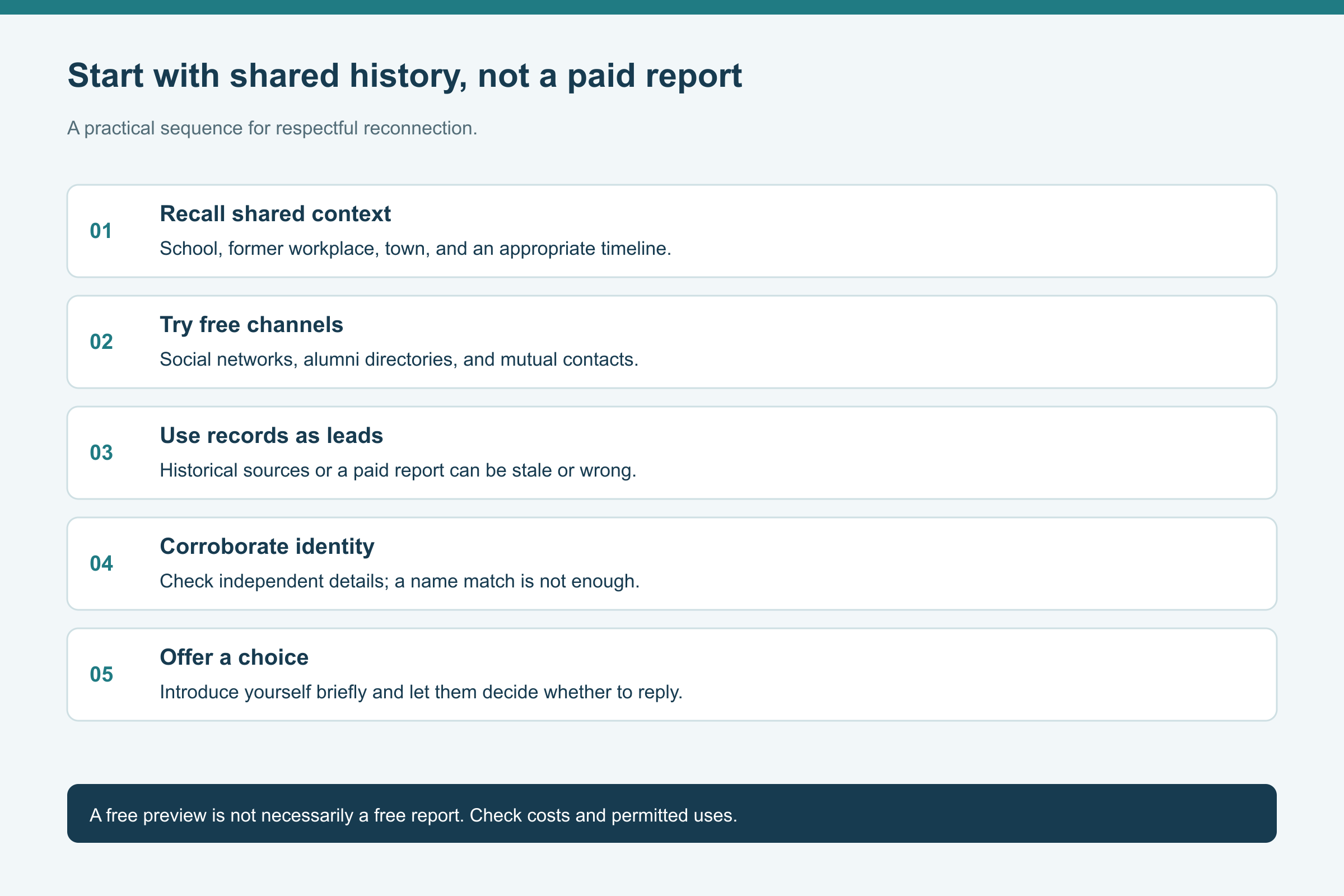
Free sources come first for two reasons. They cost nothing, and they let you send a message the other person can choose to answer.
1. Facebook
Search by full name, then narrow by the town, school or employer you remember. Older guides describe Facebook “Graph Search” queries that combined interests, workplaces and places; do not rely on them. Use the current search bar and its People filters, and check mutual friends and profile history before sending a message.
2. LinkedIn
LinkedIn is most useful for former colleagues. Search by name together with a past employer, school or city. A connection request with a short note explaining how you know each other is a low-pressure first contact. Search depth and messaging for non-connections can depend on the account type.
3. Classmates
Classmates.com is a school-based directory. Its site offers class lists, searches by maiden name, reunion tools and yearbook collections (Classmates). Free access and paid membership features differ, so check before subscribing.
4. FamilySearch
FamilySearch is a nonprofit genealogy service provided by The Church of Jesus Christ of Latter-day Saints, and says its records and family trees are free to search (FamilySearch). It focuses on historical records, so it helps most when you are tracing a family, a married name or relatives who may know where your friend is now.
5. Reddit Alumni Communities
Public alumni and local communities can help you discover reunion events or reconnect through mutual interests. Search existing discussions and follow the community’s rules. Avoid crowdsourcing a private person’s location or posting names with private addresses, phone numbers, workplaces, or family details. A mutual contact can pass along your message without revealing the other person’s information.
6. Legacy.com
Legacy.com publishes obituaries and lets you browse those published in a given town, school or newspaper (Legacy.com). Checking obituaries is a sensitive but practical step: an obituary of a parent often names surviving children, their married names and their towns.
7. Wayback Machine
The Internet Archive’s Wayback Machine stores past copies of websites (Internet Archive). Old school, club, team or company pages that have since disappeared may still list names, class photos or contact pages. Use what you find as a lead to search elsewhere.
Paid People-Search Reports
If free sources fail, aggregators can suggest a current city or a relative to contact. All of those below are U.S.-focused. Before paying, check the price and whether it renews automatically, and remember that the data may be out of date or about someone else with the same name.
8. Spokeo
Spokeo searches by name, email, phone number or address and says results can include contact details, address history, property records, social media profiles and criminal court records, noting that court records are not included in all plans (Spokeo). It invites a free initial search; full reports are paid. Its FCRA notice and its opt-out page (spokeo.com/optout) are linked in the site footer.
9. PeopleFinder
PeopleFinder.com describes itself as “powered by Intelius” and offers searches by name, phone number or address. Its site states that it does not provide consumer reports and must not be used for FCRA purposes such as employment, credit or housing, and points employment screening to a separate provider (PeopleFinder). Opt-out requests go through the Intelius privacy center linked from its privacy notice.
10. US Search
US Search offers name, phone and email lookups for U.S. records. Confirm available searches and current terms on the official site. Its privacy-request page provides a route for removal and California requests (US Search).
11. BeenVerified
BeenVerified aggregates U.S. public records into reports that can include contact details, social media profiles and criminal records. confirm current features, price and FCRA terms on the site before use.
12. Whitepages
Whitepages offers phone and address lookups and sells more detailed reports that may include property and court records. confirm what is free and what is paid on the site itself.
13. ZabaSearch
ZabaSearch offers name-based searches of U.S. address and phone records, with some results free and fuller results paid. Confirm current features and terms before relying on it.
14. TruthFinder
TruthFinder sells background-style reports. It is one of the two companies in the FTC’s 2023 settlement over accuracy claims and FCRA compliance (Federal Trade Commission, 2023). Use the official privacy-request route and check its current instructions. Processing times vary, and removing a broker listing does not erase the underlying public record (TruthFinder).
15. Instant Checkmate
Instant Checkmate sells public-records reports that it says can include criminal and traffic records, court documents, addresses and known aliases, and promotes paid access to unlimited reports (Instant Checkmate). It was the other company in the 2023 FTC settlement. As with any background report, do not use it for screening decisions covered by the FCRA.
Excluded From the Main List
- Pipl is now an identity-resolution product for businesses. Its site describes tools for fraud, risk and investigations teams and offers demos rather than consumer searches (Pipl), so it is no longer a practical way for an individual to find a friend.
- PeekYou is not included among the 15 options. Older directories may describe a service or ownership arrangement that has changed; verify the current domain and operating service before following an old recommendation.
Making Contact Respectfully
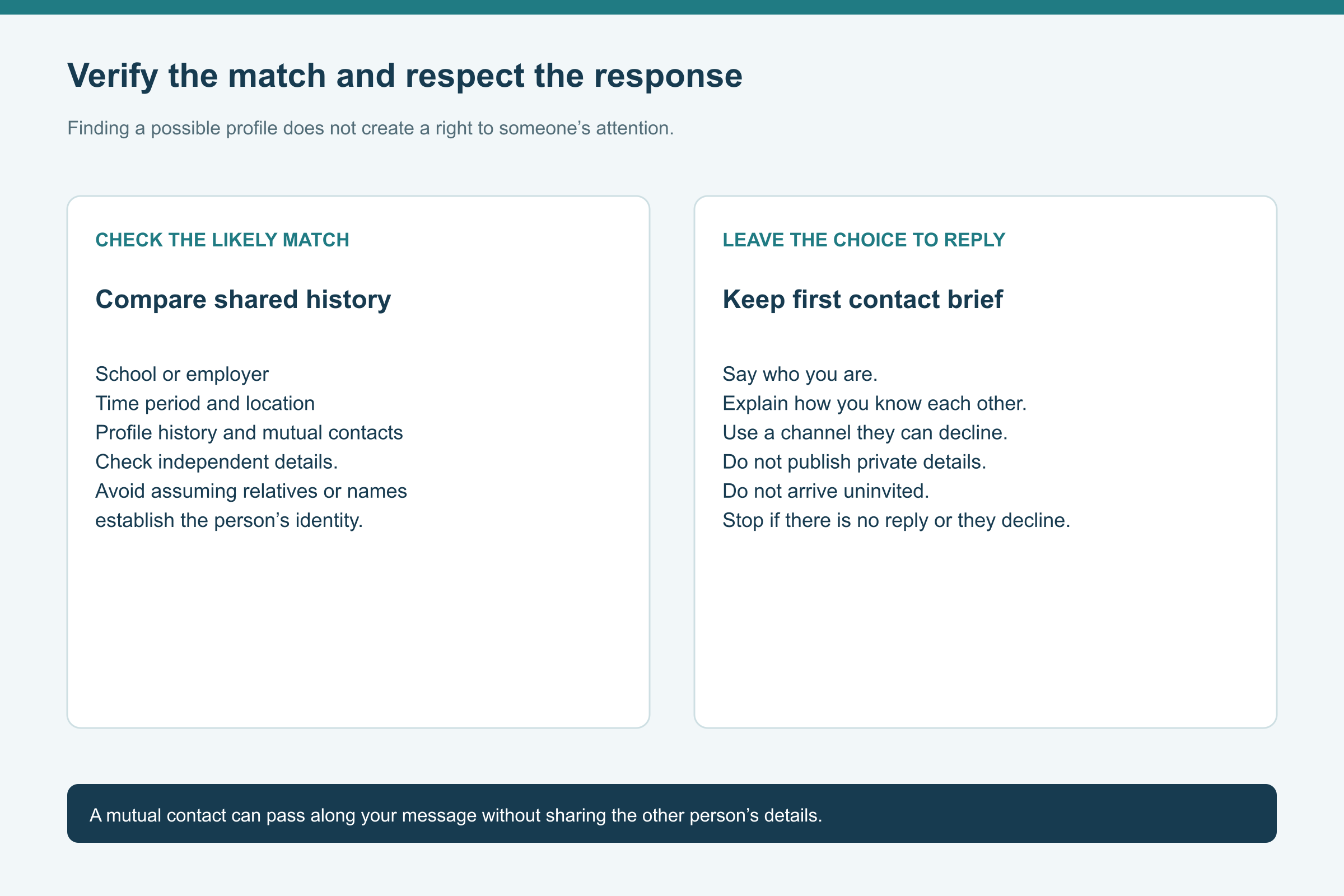
Once you think you have found the right person, corroborate several independent details, such as school attendance, a past employer, and an appropriate timeline. A fixed number of matching details cannot guarantee identity. Make first contact through a channel that lets them decline easily: a social media message, a LinkedIn note, an email, or a mutual friend who can pass on your details. Say who you are and how you know each other. Keep the message brief, avoid including private details, and let them decide whether to respond. If there is no reply or they decline, stop.
Ethical Standards for People Search
When performing a people search, follow these standards:
- Ensure legal compliance. Conduct searches within the limits of privacy laws and the FCRA, and do not use people-search reports for screening decisions.
- Respect privacy. Never share personal data you find without the person’s consent.
- Avoid illegal activities. Do not use illicit services, access data without authorization, or use a search to harass or track someone.
For how professionals confirm that a profile belongs to the right person, see the people-search verification guide.
Remove Your Own Information
The same sites that help you find others may also list you. Most offer an opt-out form; Spokeo, TruthFinder, US Search and Intelius-powered sites each link one from their pages, as noted above. the FastPeopleSearch opt-out guide walks through one site’s process.
California residents can use DROP, the state’s free Delete Request and Opt-out Platform. It opened to consumers on January 1, 2026 and sends a single deletion request to more than 600 registered data brokers. From August 1, 2026, covered brokers must check the platform at least every 45 days and process deletion requests, subject to limited exceptions (California DROP guidance). Status updates may take up to 90 days; a deletion request is not a promise that every public record or copy will disappear.
Conclusion
Finding an old friend online works best as a sequence: free, consent-friendly sources first, such as social networks, school directories, genealogy records, obituaries and web archives; then, if needed, a paid aggregator to suggest a current city or a relative to contact. Treat every result as a lead to verify, keep within the FCRA and privacy laws, and make contact in a way that leaves the other person free to say no.
References
- California Privacy Protection Agency. DROP: Delete Request and Opt-out Platform. Retrieved November 9, 2026, from View source
- California Privacy Protection Agency. Data brokers: Delete Request and Opt-out Platform (DROP). Retrieved November 9, 2026, from View source
- Classmates. Classmates.com [Home page]. Retrieved November 9, 2026, from View source
- FamilySearch. FamilySearch [Home page]. Retrieved November 9, 2026, from View source
- Federal Trade Commission. (2012, June 12). Spokeo to pay $800,000 to settle FTC charges company allegedly marketed information to employers and recruiters in violation of FCRA [Press release]. View source
- Federal Trade Commission. (2023, September 11). FTC says TruthFinder, Instant Checkmate deceived users about background report accuracy, violated FCRA while marketing reports for employee and tenant screening [Press release]. View source
- Instant Checkmate. Instant Checkmate [Home page]. Retrieved November 9, 2026, from View source
- Internet Archive. About the Internet Archive. Retrieved November 9, 2026, from View source
- Legacy.com. Legacy.com [Home page]. Retrieved November 9, 2026, from View source
- PeopleFinder. PeopleFinder.com [Home page]. Retrieved November 9, 2026, from View source
- Pipl. Pipl [Home page]. Retrieved November 9, 2026, from View source
- Regulation (EU) 2016/679 of the European Parliament and of the Council of 27 April 2016 (General Data Protection Regulation). (2016). Official Journal of the European Union, L 119. View source
- Spokeo. Spokeo [Home page]. Retrieved November 9, 2026, from View source
- TruthFinder. Remove your info [Opt-out page]. Retrieved November 9, 2026, from View source
- US Search. Information optout. Retrieved November 9, 2026, from View source
- 15 U.S.C. § 1681b. Permissible purposes of consumer reports. Legal Information Institute, Cornell Law School. View source