The best people search tool depends on your starting information and research purpose. Google and LinkedIn help discover public professional information. Consumer lookup services can surface possible contact and record associations. Pipl serves professional identity-research workflows. None turns a matching name into verified identity.
This guide compares ten options and explains how to use their results responsibly. Many commercial services focus on the United States; coverage, access and report contents vary. A paid report can still contain incorrect or outdated associations.
Quick Answer: Where Should You Start?
Start with free public-web research when you know a name, employer or username. Use a specialised lookup when your strongest identifier is a phone number, email or address. Open original sources and compare independent evidence before accepting a match.
Important: consumer people-search reports are not a substitute for compliant employment, tenant, credit or insurance screening.
Ten People Search Options at a Glance
| Website | Useful starting point | Main limitation |
|---|---|---|
| Name plus employer, place or exact username | Indexed pages can be old, copied or misattributed. | |
| Name plus company or professional role | Profile claims require independent confirmation. | |
| Spokeo | Name, email, phone or address | Aggregated associations are research leads. |
| BeenVerified | Name or a specific contact identifier | Available records vary and may be outdated. |
| Intelius | Name, phone or address | Report data does not establish present control. |
| Instant Checkmate | Name and city/state; phone lookup | Court-related matches need the original record. |
| UnMask | Name/location, phone or address | Check the scope and any linked paid services. |
| ZabaSearch | First/last name and optional city/state | Free results are limited; fuller reports cost extra. |
| US Search | Name or known contact information | Consumer reports are not regulated screening reports. |
| Pipl | Known identity attributes in an approved workflow | Professional access and contractual conditions apply. |
PeekYou is excluded from this selection because its former domain now displays a domain-control notice rather than the previous search service.
Choose the Right Type of Sourcehttps://www.peekyou.com/
Public web and profiles
Useful for discovering biographies, publications and professional affiliations. Open each source instead of relying on a search snippet.
Consumer lookup services
Useful for possible contact and record associations. Similar names, shared addresses and recycled phone numbers can create false matches.
Official records
Useful for checking specific filings or licences. Match the right person, jurisdiction, record date and relevant identifiers.
Professional identity tools
Useful within authorised investigative workflows. An identity graph or confidence score still requires informed interpretation.
How to Use Each People Search Website
1. Google: Public-Web Discovery
Use Google to search an exact name in quotation marks, then add a known employer or place. Try "Alex Morgan" "Example Company", followed by site:example.org "Alex Morgan". Open promising pages and compare role, dates and organisational context.
Shared names, copied biographies and archived pages produce false positives. Google’s search-refinement guidance documents quotation marks and site restrictions. AOFIRS’s Search Query Matrix explains why syntax should be checked separately across search systems.
2. LinkedIn: Professional Profiles
Search LinkedIn using a name and known organisation. Where available, choose people results and narrow them by relevant location or company. Compare career timelines with an employer’s staff page, publications or professional-register entry.
A profile is not automatically an authenticated CV. Similar names, stale employment details and impersonation can mislead. Access to profiles and filters depends on visibility settings and account access.
3. Spokeo: Contact-Information Leads
Spokeo offers name, email, phone and address searches. Choose the identifier you actually know, review candidate locations and distinguish historical from potentially current associations. Check report access and billing terms before purchasing.
Its aggregated contact and online-profile information can suggest research paths. It does not prove who presently controls a number or account.
4. BeenVerified: Multiple Lookup Types
BeenVerified advertises people, phone, email, address and username searches. Select the relevant lookup and supply the exact identifier. Compare candidates against information already established independently.
Available contact, property and court-related information varies. A report may combine old records or unrelated people. Confirm material findings at their source rather than accepting the summary as verified.
5. Intelius: Names, Phones and Addresses
On Intelius, choose a name, phone or address search. For name research, add the known city and state when useful. Treat the returned contact, location and relationship associations as leads.
Shared addresses and reassigned numbers can connect unrelated people. The provider’s disclaimer excludes eligibility decisions covered by the FCRA; ordinary consumer access is not employment or tenant-screening authorisation.
6. Instant Checkmate: Public-Record Leads
Instant Checkmate presents people and reverse-phone searches, including possible criminal and traffic-record information. Enter a full name and relevant city/state, then compare identifying details before opening a report.
A similar-name court match can be particularly harmful. Check the originating court, case identifiers and disposition. An arrest is not a conviction, and a database entry is not proof that the record belongs to your subject.
7. UnMask: Basic People Lookup
UnMask presents people, phone and address lookup options. Select the appropriate form and add the known location to a name search. Inspect candidate details and distinguish the advertised free search from any linked or expanded report offer.
The website’s marketing is not an independent accuracy assessment. Do not assume that listed records are complete, current or correctly matched.
8. ZabaSearch: Limited Free Discovery
ZabaSearch supports first/last-name searches, with city and state to narrow candidates, and reverse-phone lookup. Its public page describes limited free information and paid expanded reports.
Use the initial result to identify a possible lead. Do not confuse a former address or partial phone match with a confirmed current identity. ZabaSearch is powered by Intelius, so agreement between them is not automatically independent corroboration.
9. US Search: Consumer Record Research
Use US Search to begin a people search and review candidate associations against known context. Its public page describes contact, social-account and record-related information. Check the current offering and membership conditions before buying.
Historical contact data can be useful but does not establish present residence or ownership. The provider excludes consumer-credit, employment, insurance and tenant-screening decisions requiring FCRA compliance.
10. Pipl: Professional Identity Research
Pipl positions its products for enterprise fraud intelligence and professional investigations. Pipl Search connects identity attributes within its identity graph; it is not interchangeable with a free consumer directory.
Within an approved account and permitted purpose, query known attributes and inspect the supporting associations. Evaluate source context, timing and alternatives. Neither an automated match nor a confidence score independently proves who operated an account.
Why a Match Does Not Prove Identity or Origin
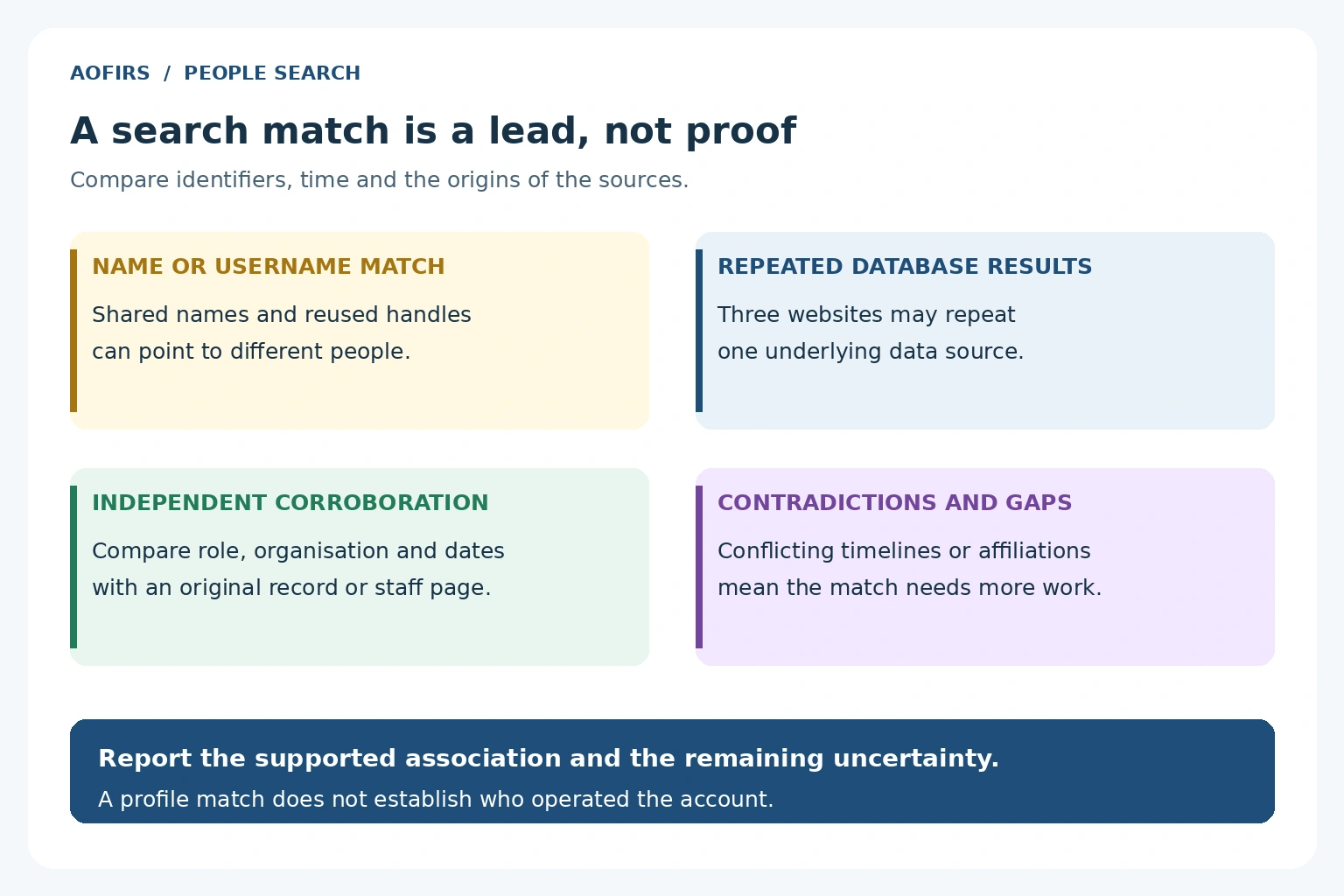
A matching name, username, photo or location can belong to someone else. Accounts can be copied, shared or compromised, and old contact details can be redistributed. Several websites may repeat one dataset rather than provide separate confirmation.
AOFIRS’s guide to verifying people-search results explains how to compare identifiers, source independence and discrepancies. A supported connection to a profile still does not prove authorship of a particular message or the origin of a photograph.
A Practical Verification Workflow
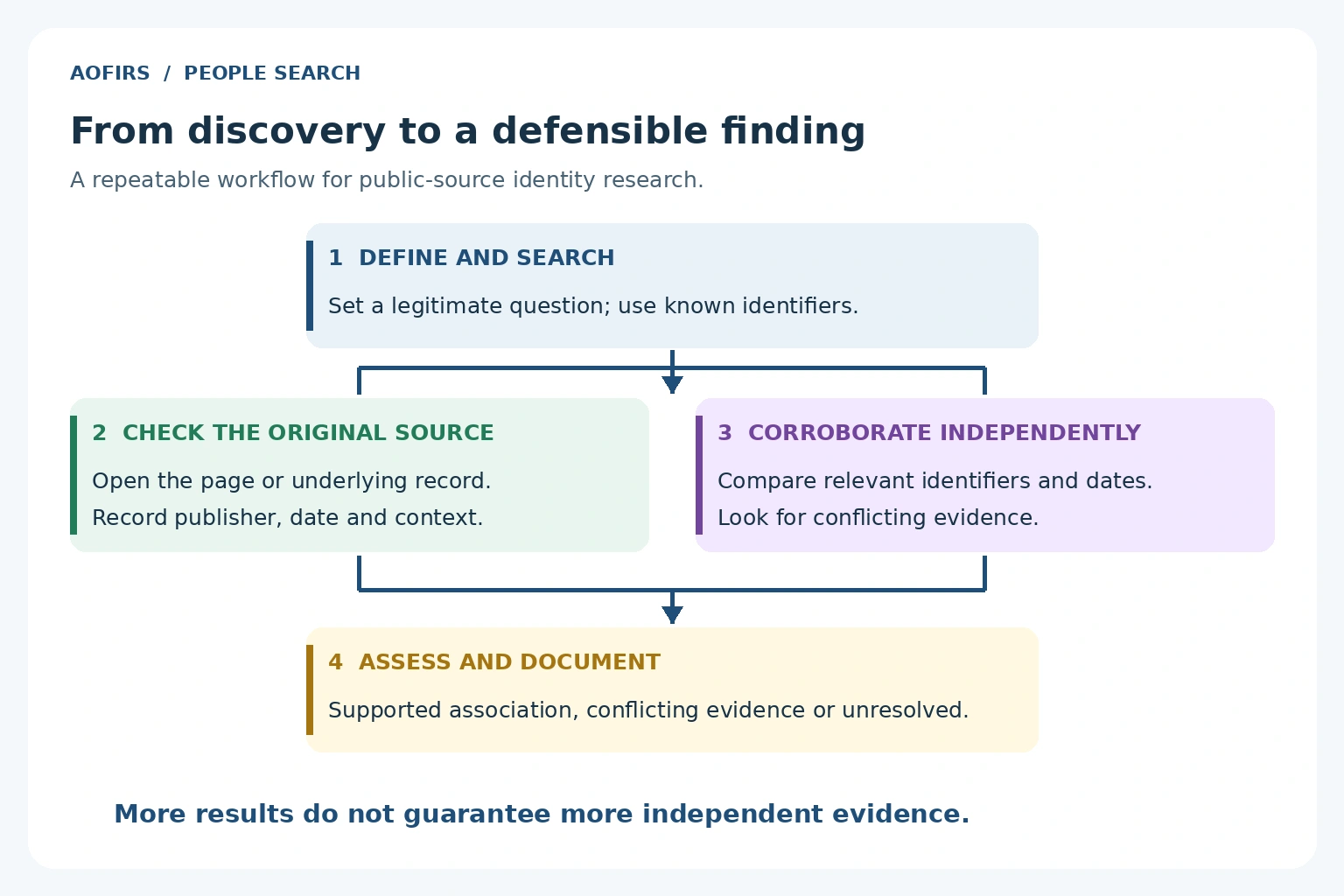
- Define the purpose. State the claim being checked and collect only relevant identifiers.
- Search from what is known. Use exact names, organisations or identifiers; keep uncertain candidates separate.
- Inspect original sources. Record the publisher, date, URL and the actual claim.
- Corroborate independently. Compare relevant roles, locations and timelines, including contradictions.
- Report uncertainty. Distinguish supported associations, unverified leads and unresolved matches.
For original-record checks, use AOFIRS’s practical public-records guide. For handle-based discovery, its username research guide explains the need to inspect profiles beyond matching handles.
The Verification Methods in Private & Public Information report adds a broader framework for documenting findings and interpreting evidence. Check the exact research question before choosing a source.
AI Assistance, Privacy and Permitted Uses
AI can organise query ideas and notes, but it may merge unrelated people or invent connections. Open every cited source and verify what it actually says. The AOFIRS AI Trust Illusion visual guide explains why fluent answers can create false confidence.
Use public information proportionately. Avoid unnecessary collection or sharing of home addresses, family details or other private information. Respect platform access conditions and a person’s choice not to engage.
For regulated U.S. screening, follow the appropriate process rather than repurposing consumer reports. The FTC’s employer guidance explains employment consumer-report obligations, including notice, written permission and adverse-action procedures. Other purposes and jurisdictions require their own checks.
Frequently Asked Questions
Are free people search tools reliable?
They can support discovery. Free and paid results both need independent verification; payment does not guarantee accuracy.
Which tool should I try first?
Start with Google for public-web information and LinkedIn for professional context. Use a specialised lookup for a known contact identifier.
Can a phone match identify the current owner?
Not by itself. Numbers can be reassigned or shared, and database associations can be historical.
Does matching a username prove account ownership?
No. Handles can be reused or impersonated. Compare profile context and independent links.
Can I use consumer searches for hiring or tenants?
Do not substitute consumer lookup reports for compliant screening. Check the provider’s restrictions and applicable requirements.
Are several matching databases independent evidence?
Not necessarily. They may share ownership, data suppliers or copied records. Trace the information’s origin.
Can AI verify a person’s identity?
An AI-generated association alone cannot. Evaluate the original evidence and record any gaps.
What should a verification note contain?
The question, identifiers used, source URLs, access dates, relevant findings, contradictions and remaining uncertainty.
Conclusion
People search websites help locate possible associations. Choose tools by their inputs and coverage, then check original sources and independent evidence.
The useful outcome is a documented finding with clear limits. When evidence conflicts or remains incomplete, report an unresolved match rather than forcing certainty.